

 Spotify
 iHeartRadio
 Amazon Music
 Apple Podcasts
 Pandora
 Youtube Music
 PlayerFM
 Overcast
 PocketCasts
 Goodpods
 Podyssey
 Audible
 Podchaser
 RSS Feed
 Stop Overparenting on Ask Mom Parenting with Sue Donnellan
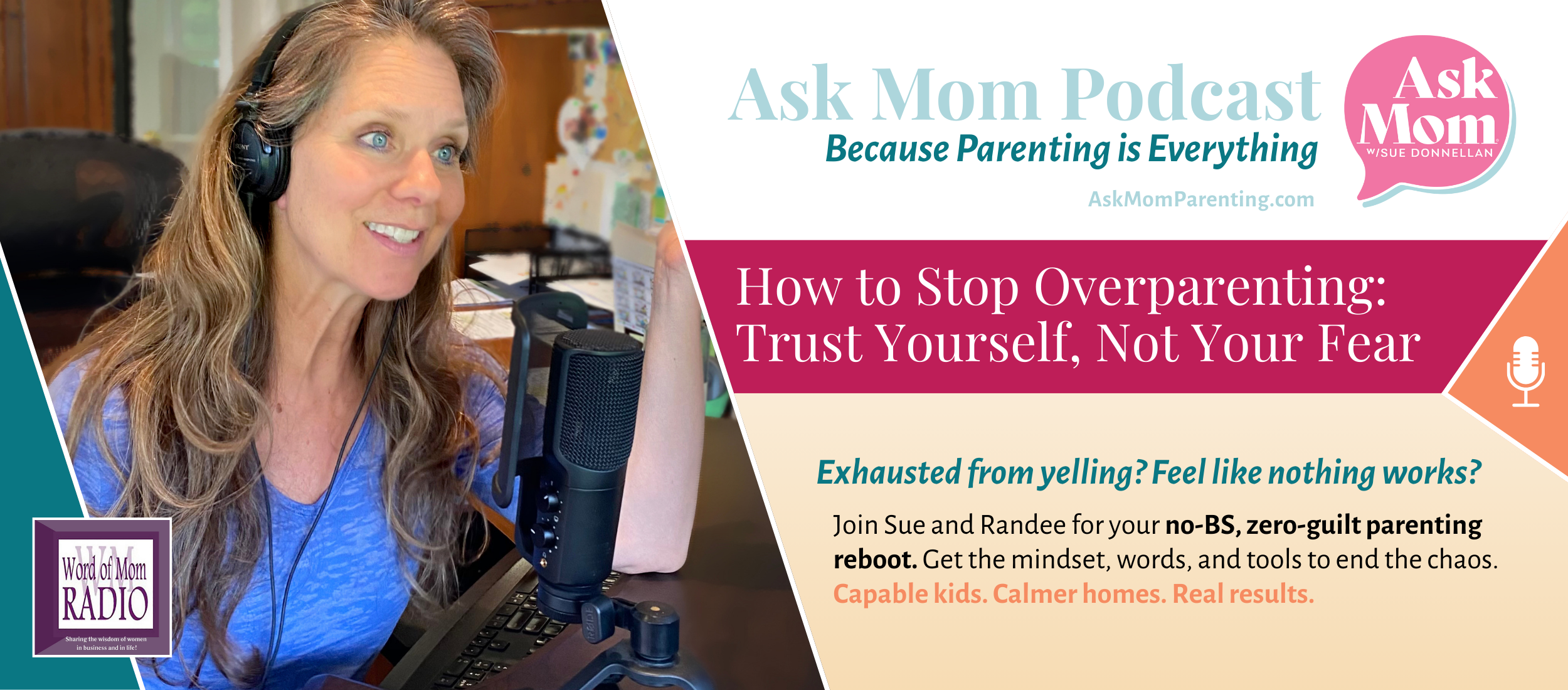
Sue Donnellan Shares How to Stop Overparenting: Trust Yourself, Not Your Fear!
How to Stop Overparenting: Trust Yourself, Not Your Fear!
Are you doing everything for your child…and calling it love? In this episode, Sue peels back the curtain on overparenting and calls out the subtle ways control shows up (micromanaging, rescuing, rushing, rewriting their essays) and how it can backfire.
With insightful stories (including the moment a Montessori teacher politely called her out for still packing lunches), and real talk about self-awareness, fear, and the difference between leadership and control, Sue walks you through how to step back without falling apart.
In this episode, Sue peels back the curtain on overparenting and calls out the subtle ways control shows up (micromanaging, rescuing, rushing, rewriting their essays) and how it can backfire.
Spoiler: Letting go isn’t giving up your authority, it’s how you gain influence and raise independent, resilient kids who actually want to talk to you because they trust you and don’t feel judged by your control.
What We Talk About:
The sneaky ways control hides in “good parenting”
- Why micromanaging robs your kids of confidence, and you of your sanity
- How fear fuels overparenting (and how to stop letting it drive the car)
- The “structure not a script” strategy to give kids autonomy within boundaries
- Why overcontrolling kids can turn them into rebels, people-pleasers… or liars
- A decision-making skill you’re accidentally preventing your kids from developing
- Instrument practice, friend choices, and the tightrope between encouragement and control
- The parenting question that will change your day: “Am I helping or hovering?”
- Your challenge for the week: Pick one place to loosen your grip and watch what happens
One-Liner to Remember:
"When we prevent our kids’ discomfort, we also prevent their growth. You want to raise a problem-solver, not a puppet."
Parenting Power Tools From This Episode:
- Boundaries vs. control checklist
- Facilitator parenting model (structure, not a script)
- Micro-moment practice: let them fail safely
- Mantra: “Am I helping… or hovering?”
- Connection-first strategy to build trust, not obedience
Listener Challenge:
Pick one area where you’re over-involved. Is it homework? Doing laundry? Friend drama? Step back…on purpose. Let your child try. Let them fail safely.
Then watch them rise. Rate + Review:
Loving these no-filter conversations? Drop us a review and share this episode with a friend who needs to hear, “Hey, you don’t need to do it all.”
🔗 Links & Resources:
· Free Facebook Group: Yell-Free Parenting for Exhausted Moms
· Sue’s Book: Secrets to Parenting Without Giving a F^ck
· Want 1-on-1 coaching? Book here
· Get Sue’s Weekly Newsletter: Subscribe now
WordofMomRadio.com - sharing the wisdom of women, in business and in life.
Become a supporter of this podcast: https://www.spreaker.com/podcast/word-of-mom-radio--5252572/support.
0:01 She is brave, she is bray, she is she is you. You're tuned in to Word of Mom Radio here on the Word of Mom Media Network. Hi, and welcome back to the Ask Mom Parenting podcast. Because parenting is everything. I'm Sue and with me is Randy, and this is your no bullshit, no filter, and zero guilt parenting reboot. Whether you're deep in. The toddler tantrums, navigating between, or teen drama, or somewhere in between, you'll get clarity and actionable tools one episode at a time. Today we're diving into something that almost broke me as a mom, and that's being controlling. Episode three is how to stop overparenting. Trust yourself and not your fear. Here's what I've found as one of the hardest and also the most rewarding things that we can do as a parent, and that's to learn to let go and step back from being a controlling or micromanaging parent.
0:54 And here's the kicker. The more we try to control our child, the less control we actually have. If we think we're keeping it all together because we're running the show, what we're actually doing is inviting our kids to lie, or rebel or just basically survive our grip. The irony of being over involved as a parent is that letting go is actually how you gain the influence and connection that you're looking for. Here's a counterintuitive twist that I discovered. You have to lose control to gain control. This topic is such a personal journey for me. During this podcast, I'm going to share a story about the moment that I realized I was doing way too much as a mom. Well, unpack some hidden ways that control sneaks into our parenting, and I'll give you a real world plan for how to let go yourself without letting things fall apart.
1:42 The topic of control is very interesting because this actually really surprised me as a parent. I did not think I would see control come out in the way that it does come out. I thought, you know, cool, calm and collected and kind of what pair and my kids, how my parents parented me, And that's not really the case, which I find interesting, and I kind of think a lot of that has to do with the world we live in today, because for me, control comes out in ways that you don't necessarily think is control, and it takes a while to uncover and realize that that's what you're doing. So for me, like I never thought I would experience control as much as it is. It's actually something I'm kind of actively working through because, like I said, it just very small ways. One of the ways that I see the most, and I think a lot of parents today can relate. Were much busier than I think parents were in the past, and a lot of times my control is just simply it's because of time, and I have only started to recognize that recently. We need to get somewhere, you know, there's no time for the mess, the meltdown or anything like that. So for me, that's been like a big realization that I've had and actually something I'm like actively working through right now.
2:58 That is my experience. It's not control if it's not love. Right, A lot of times we're trying to figure out how to get from A to B, and we I don't realize that we're applying control, and we don't realize that we're putting our own opinions into everything and that we just want it done sooner. And that was pretty much my personal journey as well. When I'm working with parents through workshops and we try to get to the bottom of how control is seeping into your parenting. We start with a little self honesty check, and there's some common ways where we can justify holding on too tightly, and parents tell me things like, you know, I'm just keeping them safe. Well, you know that's totally fair until safety becomes a cover for micro management, right, and you know, I don't have time to let them do it themselves.
3:40 That was really my thing. I need it done. Fast, I need it done my way because my way is the better way. I've had X number of years on this planet. And they're just learning, so it's easy to kind of interrupt that process and place efficiency overgrowth, and you know, in so doing, hijack their independence. And you know, in my case to it wasn't necessarily fear that had me controlling the kids and the outcomes of what was happening, but it might have been you know, if I don't do it, it won't get done right type a personality. Right, It's like it's perfectionism pretending to be helpful. If I'm not doing everything for them, am I really being a good mom? That one seems to resonate with many of the moms that I work with. You know, but we need to trust our kids decision making and give them that space to decide and to choose and to experience life's pitfalls without rescuing. The reality is that control is a response to fear many times, the fear of failure, the fear of chaos, the fear of sometimes not being enough. And you know, when we prevent our kids discomfort, we're also preventing their growth and their ability to become resilient to life and its challenges.
4:49 And so what we're really looking for. Is to raise kids who can work through disappointment, fear, and mistakes without constantly having to be stepping in exactly. And I think it's hard for parents to admit or even have the self awareness to see if they're the ones benefiting from the control. And I know that's something that you talk about a lot, which it was a concept I actually found really interesting because I think you kind of need to apply some self awareness to acknowledge that is something that can actually happen, and then kind of look at yourself and apply that self awareness. Can you give us some examples of where it might be more about us than the kids? Oh my gosh, yes, And I lived every single one of these. Are you doing their homework because you feel like you're just being the good parent where you know, my husband was always really good about letting the kids figure stuff out, no matter how painful, and I was stepping.
5:40 In going you know X times this equals this. You know, boom, you're done, move on, and you know nobody was learning anything. Or when you push them toward an activity because it makes you proud, but maybe that doesn't make yourself fulfilled. But that's the activity that you want to see them doing. For me, I love dance, and you know, my daughter didn't really care for dance as much. We tried it, but you know, I did have to step back and listen that even though it was something that built confidence and happiness in me, wasn't. Resonating for her. Or you know, if you're jumping in to fix something just because you can't handle watching them struggle, or maybe you. Don't like the decision that they've made. Do we know that after our life's experiences, maybe they can do it this way and it would save them time and effort. But we're really not teaching them how to solve their own problems, how to apply ingenuity to any kind of problem solving, or to create their own confidence.
6:29 One of the stories that. Really I like to tell because I think it very much illustrates the level of control, you know, that I needed to have, or that I wanted to have to just get things done. Of Course, remember, you know, four kids under. Four, but anywhere, at any age it was always four kids, and three of them were at the same age. So we had the kids in a preschool and my oldest was in kindergarten at this Montessori school. And I remember we had a parent teacher conference and I was running late, and of course got the sweaty browthy I'm waving my brow like, sorry, I'm late. I was busy packing all my kids' lunches, and surely you can understand that I just, you know, barely get it all done. And the teacher just looked at me, completely unimpressed, and said, why are you still packing their lunches?
7:14 Now? Mind you, the kids were five and three, and I just thought, this lady, she's crazy. She forgets what the grinder feels like. And I just said, well, why wouldn't I be packing their lunches? And she said, well, are you aware of all the things they do in class when they're here? Do you know that they grind coffee, and that they. Serve their friends, and that the kindergarteners serve as leaders and role models to the preschool kids, and that they have a peace rug, and whenever the younger kids are fighting, the kindergarteners step out onto the peace rug and they help solve problems. Like they're doing all of this stuff that they're expected to do at school that I'm not expecting them to do at home because I'm.
7:54 Busy doing everything. Well, that day it changed. I put that mir around myself and was like, oh, okay, well why am I packing their lunches? And I redesigned the whole kitchen. I put everything at their level. I remember getting frustrated that I was screaming out to the kids. While they were eating, who what you want? The blue juice or the red juice? Who want? And just you know, pissed off that they weren't answering me with the flavored juice while it was thankless I was packing their lunch and you know, you don't have to tell me twice, right, So I didn't need to be controlling their process of packing their own lunch and packing what they want to eat I was in control of shopping for the food, cutting the fresh fruit, putting everything at their level, providing the juice for them, and giving them you know, you need a protein, you need a fruit, you need whatever it is, these as the components you need. So from a more facilitator role, I could step back and watch them pack the lunch. But I didn't have to be packing the lunch. Did they have to get up a little earlier.
8:46 Yes. All of the things that they had to do to take ownership for themselves that didn't require my intervention was all stuff that I was learning on how to manage a family of six and how to get a job done with four kids. And that was just a big, I guess, just light bulb moment for me that I didn't have to be packing. Lunches of little kids. And they packed their lunch all the way through high school, and in fact, they said for years over how all of their friends threw away half the stuff their moms packed because they didn't pack it and they weren't going to eat it. So anyway, that was a life lesson for me in terms of how it benefits me to let go of control, let go of micromanaging, and where that is going to add value in my life and in theirs.
9:32 Yeah, definitely, I can totally relate. I'll never forget my daughter. She's almost eleven, and she's had an interest in cooking, baking and everything culinary for like years, and she was like, I don't know, probably between probably around five, and we watched I was a Food Network show where the kids were like cooking in competition. It was a kid's competition, cook and Hill, and I remember them saying I started cooking when I was four or five, like helping out in the kitchen. And that's the day I looked at her and was like, well. You like this? Do you want to start helping out? And if I didn't see that show, it never would across my mind that kids could start cooking, like obviously with supervision and things like that and the safety measures in place, but actually be in.
10:19 The kitchen cooking. That was an interesting moment for me where I started to kind of expand what I thought the kids could do. It's interesting you brought up the instrument and situation because we actually just kind of went through something similar. My daughter just became of age in their school last year where they could pick an instrument, and she liked it at first, and then it sort of started to fizzle out, so, you know, toward the end of the year, I was like, you know, is this something you still want to continue? And she kind of wasn't sure. And my perspective was, if you don't like it enough that you're willing to practice fifteen minutes a day, three days a week, maybe this isn't for you, And that was kind of the deciding factor that it wasn't for her. Then she came back to me and was basically, other kids are like, their parents are making them do this and they don't want to. So when you mentioned that, that really kind of resonated because I was, wow, like, I'm actually kind of seen that a lot, where the parents are like, you have to do this even though the kids don't want to, and it's clearly for whatever reasons all and I'm sure it's different for everyone, but something they're benefiting from where they want. And so that was really interesting that you brought that up, because it was something we were like just experiencing this past school year.
11:33 I think it's a little much of a kind of conundrum now that my kids are older, they do regret that they didn't stick with piano or any of the instruments. Okay, so there is a fine line between being controlling and parenting, and I know we're going to kind of get to that down the line here in our podcast. The fine line is when do I encourage? When does encouragement become control? Right, And we have to really be able to step back, and you know, we'll get into to some of those signs here in a bit. But it's interesting that, you know, kids have been given the choice, they don't always want to do things, So we do have to encourage, We do have to provide the kind of that leadership role and be a facilitator because we do know that down the line it's going to beneficial for them to be able to sit down and go play a piano or pick up a guitar or saxophone or whatever event or activity we're talking about. But it also is important to zoom out and listen to the kids and understand what's my skin in this game, and that's going to kind of help you delineate whether it's a controlling and hovering moment or whether it's an encouraging moment. Overparenting and you know, being controlling will wear a lot of disguises. So there's a checklist that I like to run parents through to help them identify when it's control or whether it's being a good parent. One of the questions you can ask yourself is do you always need to be right? I will admit that was my weakness. I'm type A, I'm an entrepreneur, i make all my own decisions. I'm very empowered.
12:59 It's not like I need to be right, but I did feel that. Of course, they're little kids, I'm going to be right more than I'm wrong. You would have to really get it, check yourself and say who cares right? Let it flow. We don't have to. We don't have to insert ourselves and the kids that's the only way they learn is if we don't insert ourselves. Also, do you have a need to say I told you so, even if it's just in your head? They admit, you know, yes, yes, that does feel good. You know there are times that E didn't say it out loud now, but now my kids are older, so I'm okay. I mean we laugh about it, but you know, are you thinking to you something? Yeah, I told you again that skin in the game. We need to sort of self check and say, is this is this helping or hurting? Do you swoop in and try to take care of things before your child can struggle or fail?
13:48 If so, that could be an ego thing talking. That could be you not money to be. Judged, or that's masquerading as good parenting because you were there to help, but it's actually a controlling maneuver on your part. Kids get a little older, are you emailing the coach about playtime or are you rewriting your kid's essays so they don't fail. The older the kids get, I have found the higher of the stakes when they're little and they're tying their shoe or they're not wearing their coat and you're telling they have to wear the coat. Yeah, it's good to start learning to pull back at that time and at those ages. But by the time these kids are preteens, if you have not learned to stop your hovering or stop the overparenting or or your involvement is really going to boomerang on you. But your kid is going to lose credibility with the coach. Your teacher knows what your child's capable of.
14:33 If all of a sudden there's this fantastic essay written. It's your hand. You know it's not doing your child any favor. So those are some of the ways that we can sort of self check. Are you involved in every daily moment and the outcome of those moments, and if you are, one of the side effects of that is that it drives your kids to lie to you. So why does your overparenting, you're controlling drive your kids to lie? Well, because the only way that it's child can create space to make their own decisions is to lie and tell us what they think the right answer is. When we're controlling, we've got a tinge of judgment. We're implying that there is a right answer, and the right answer is what we think. The child is not going to sort of get in touch with what they feel and what their thoughts are. They're just going to give you a mime of what it is they think you want to hear and what you're looking for. But they're not deep diving into what they think and feel and they're not formulating their own thoughts. I can recall a time when my mom back in the eighties seventies, we were grounded, we were punished, and I lied to my mom all the time, and I really sat with myself and decided, why am I doing that? Why did I lie to my mom? Because I don't want my kids to feel like they have to lie to me. Her grip was so tight at that time, just really micromanaging me, and I've really felt under a microscope and it really didn't leave any room for honesty. Right. Lying to me was just about trying to claim some sliver of independence and to back away from the glare of her judgment.
16:03 And you know, I'll tell her what she wants to hear, so she'll just go away, and then I'll do. What I want to do when she's not looking right. So, like you know, when our kids feel that they can't make mistakes, they'll either rebel or they'll become people pleasers. And I don't think we want to raise either one of those types of kids, right. We want kids to get. In touch with their inner selves and make satisfying choices within our boundaries and learning from their own mistakes to build their own wisdom beyond their years. Here's the shift on how to start letting go. And this is where I did some work on myself and how I was able to finally let go. And if this podcast this topic is resonating for you, remember that letting go of control is not about giving up your authority. You're stepping into more of a leadership role, which is exactly what your kids need from you. So you're moving from more of an overparenting situation to being a facilitator who helps their child discover their own way, but yet just with your life guidance. So when I'm working with parents and workshops or we're working through coaching, one of the places that we start is that as parents, our job is to provide structure, not a script. So we don't want to tell them what to think and how to feel.
17:13 We're just providing the structure, but we're not telling them how. To solve it. So as a parent, it's also very. Important for us to trust ourselves, which is why I put that in the title of this episode, because a lot of times we're living in fear or we're parenting in fear, and we're not really trusting our gut, we're not listening to ourselves and listening to the child and really relying on that to guide us. When we trust ourselves, our children learn to trust themselves. We're setting clear boundaries, but we're giving them freedom within those boundaries, and a little helpful saying remontra is to ask yourself, am I helping or am I hovering? When we stop controlling and hovering, and when we zoom out and let our kids try to make some of their own decisions and their own mistakes and fail, here's some of the things that the kids can start doing on their own without our involvement.
18:01 They can make their own lunch, like we talked about. They can pick their own outfit, no matter how silly, no matter how ridiculous. I can remember my son fourth grade wearing a cowboy hat, camo, cowboy boots, you know, whatever he felt like putting on he wore and oh wow, like wait did he walk holler that day? So I just you know, you let it go, you smile and wave, let them choose their friends. I can remember one of my kids having a friend who checked every box on what a dangerous friend would be. I just I really had a soft spot for this kid. Instead of saying, you can't see this kid because you know, he's doing all sorts of things that are beyond his years that he should be doing. And I can see the trouble coming.
18:42 But the relationship and connection that we had with our son allowed us to trust him, and that meant letting go of control. That meant trusting him, That meant allowing him to make the decisions and choices, and just keep the line of communication open because again, and we're controlling, it puts our kid in an environment where they want to lie to us, So you're not creating a connection. They're just telling you what you want to hear, right, and then just discovering their passions. If something doesn't make sense to the child, that's okay, just let them figure it out. It doesn't need to make sense to us. It just needs to make sense to them and let them kind of get through it. So more choices and more consequences experienced.
19:25 Boy, I got a lot to think about. This episode has been so wonderful and just like taking it all in because it's definitely some things that I'm going to go back and apply in my own life. Definitely. I loved when you said giving up control doesn't mean we're giving up our authority, because I do think I've questioned that myself, like where's that balance? And I think that's going to resonate with a lot of people. I'm kind of going through similar things right now. My daughter's basically in those tween years, which I actually love right now in a way, and it's coming to me as a surprise. It's really nice because she's not quite a little little kid anymore, and she's not like a teenager yet, so it like really surprised. I was like, uh, I wasn't sure how it was gonna be, you know, but I actually enjoy it. But choosing friends where I'm at right now, we let her, you know, use a little bit of technology to message friends and things like that, and there are some things there that I'm like, oh, there's a couple of friends though, but a couple of red flags. But I just had to take a deep breath and let her choose her friends and just you know, kind of talk to her about relationships and friendships and and what makes a good friend and not and sort of things like that. Yeah, that one. It's it's like harder than I thought because I definitely had friends that my parents.
20:43 Did not like. They made that clear, but they did not tell me I could not hang out with them. And at the end of the day, when those friends did choose the wrong path or what made wrong decisions? I didn't, and so that's helping me, you know, shape this, you know, with my daughter. And you know, what do you think your parents did that allowed you to stay on your path even though they allowed. You to have these friendships. What do you think they did kind. Of really just instilled I think some values, like stressed to me the importance of education and things like that, because you know, some of these friends were like skipping school and like smoking cigarettes, and you know, at that time, like my parents were smokers, and they gave me education on why I shouldn't be and it was something that they had always regretted and so things like that. So just kind of that education and like we know this one smokes, I see her down the street smoking, or this one's skipping school. A little education in a way of you know, and encouraging me to choose, you know, still make my own decisions and expressing the importance of education and like what life could be if you know, I stayed on the right path, really and then backed away saying, you know, we knew, we know these kids are doing this. Back away and you know, kind of let me make my own choice. So that's definitely what I'm trying to do right now too.
22:02 One of the strategies that I used and I try to help teach in some of the workshops is I had a strategy of keeping the kids productively busy, and that meant having certain expectations. So that meant, you know, earning money. Whether if you're eleven or twelve, you could be babysitting, or you could be mowing lawns, or you could be doing stuff on the side. It meant doing a sport of some sort or some extracurricular activity. We always had certain expectations that kept the kids productively busy. Kids need downtime. I'm a huge fan of no homework. Actually, I think it's ridiculous. That's just you know me. There's a million other things kids could be doing that are that are going to teach them how to live a life, balance a checkbook, you know, pay rent, make money, invest There's all sorts of life lessons and tips and tools that we are not teaching kids in school. But that's another podcast.
22:50 Keeping kids productively busy, making sure that they are out adding value to developing skills for themselves and adding value to the world. Around them, and it takes a lot of hands on parenting. It's not coming from a control standpoint as much as a managerial leadership role. Again, as a leader, I'm setting the tone for boundaries. I'm setting the tone for expectations. Within those expectations, you have a multitude of choices that I will support. And if your child has other things going on in their life when they are with that friend, we would say, great, yes, go see your buddy, but you get two hours because we have to get back for such and such, right, So it's controlled chaos. It's a very tightened situation that again allows them to make their own mistakes and learn. But when you're not overly controlling and you're not overly micromanaging them and their decisions and the people they hang out with and everything that they're choosing, that builds that connection. And the bottom line is that connection and that relationship. And when you are in a controlling situation, which I know I grew up with, I just managed the environment in the best way that I could, which is to tell my mom what she wanted to hear, and then I moved on and she never had any insight or private details into my life.
24:09 I just didn't feel comfortable sharing that. So that's the goal of this whole topic and this whole parenting strategy is to how to create that connection, how to create and make those relationships tighter, especially in the preteen years. Right, you want your daughter to tell you, Hey, these are the choices my friend is making, and they don't want to feel that you're going to judge them or take that friend out of rotation. So give it up control for a lot of parents can feel really scary. So where can a parent start giving up control about feeling like their whole world is going to fall apart? It is scary, I will admit as like I said, this is a very personal journey for me. But I suggest recognizing yourself in some of these statements. The fear, the reasons why asking yourself?
24:51 Are you drilling down? Do you have too much skin in the game? How is your child reacting to your involvement? First of all, self check if you recognize yourself of as being that way and getting pushback from your kids and you don't know what else to do, right, So here's where we start by self recognition. And then we start by just picking one micro moment where you know that your kid is giving you pushback or you actually are wondering why am I getting resistance here? Let your kids pack their own backpack, and if they forget something, you. Do not save them. You do not go back and bring their cleats for football back to the school, right, you do not, because guess what if you do that, they will never ever pack their cleathes or feel that they have to go through their checklist or even create a checklist.
25:40 But if they forget their cleathes once and. They don't get to play that day, all that hurts and that's memorable, and they won't do that again. You cannot rescue. I know it's hard, Trust me, I've been there. They can pack their own backpacks, they can pack their own lunches. That's how they learn. You want to let them fail, and you want to let them fail safely and then let them rise. And when they rise, they're doing it on their own. Here's what happens when we start learning to step back and just let kids discover life on their own. You know, they stop feeling like they have to lie to please you, and they start to feel trusted, and then in so feeling trusted and they become more trustworthy, they get better at solving their own problems, and they feel less judged, so they learn more and you stop yelling and your child starts thriving.
26:25 There's a multitude of reasons to zoom out, let go, and let your kids figure out life on their own and not be rescued. So we don't have to have a say in every decision and every choice and every idea of our kids. Once I started living in the moment and letting it unfold, I relaxed more, and I became a more fun mom, a more fun wife, and I enjoyed myself more. Actually, I was making my life a lot more complicated the more I tried to drill down in control that was actually causing me pain, and I didn't realize it right. Once I let go, let them do their laundry and let them pack their lunches, it was, oh wow, lot less shit on. The table for me to have to handle.
27:06 So it takes an knowingness to know what is yours to guide and what's theirs to learn. And that's pretty much the distinction. I can't control your feelings, but I do control how we treat others. So there's that little splitting of a hair there as to how we walk that fine line as to being a leader and a parent that creates the culture and creates the boundary and the expectation. But then how I finally tap out after that and let the kids have that freedom from there? Here's your challenge this week. What's one area where you think that you can soften your grip. What's one place that you can let your child step up, even if it's just a little bit. And where are you holding on out of fear instead of trust. You want to first start learning to trust yourself and then by default, you'll start to trust your kid and they'll start to trust themselves, and that's where the work begins. But that's when the magic happens.
28:00 Thank you so much for listening, and I hope you found this helpful. If you'd like to learn more, my website is askmomparenting dot com. It's also as mom Parenting on Instagram and Facebook. I have a Yell Free Parenting group, a private group on Facebook Yell Free Parenting. I do posts every day. I have a lot of great content in there that you're able to join. I look forward. To talking with you next time and feel free to reach out in any way. If you have questions or to have topics that you want to hear about. Thanks again and we'll see you next time. She is sure, she is sure, she is strong, she is strong, she is true, she is true, she is braise, she is she is you, she is you. She she is sure, she is sure, she is strong, she is strong, she is true, she is true, she is braise, bray, she is she. She is you.
28:56 She is you, she is you. She sure of herself. Yes, she takes care of his Powerful and strong. Yes, she knows who she is has integrity, woman, strong and true. You know her by name. See this woman is you. She is sure, she is strong, he is strong, she is true, is true, she is brave, she is bold. She is you. She is you, she is she is sure, she is strong, is strong, she is true, is true, she is brave, she is bold, she is she is you, she is she is adds value and hope has proved to be brave.
29:40 See it's never too late, never time to behave reaching for dreams doesn't matter. The age believes in herself, unleash from her cage. She is sure, she is she is strong, is strong, she is true, is true, She is brave, she is bold. You she is she is she is sure, she is strong, she is strong, she is true, is true, she is brave, is brave, she is she is, she is you. Okay mm hmm

As a mother who has balanced raising four kids (including triplets) with a full-time business and a husband who deployed to combat five times, I fully understand the demands on parents to successfully manage a busy family life. The steep learning curve of going from one to four children almost instantly kickstarted my methods for nurturing four unique individuals. My no-nonsense, judgement-free parenting style created an environment of freedom, flexibility and self-initiated learning for our kids. After twenty years in the trenches, parenting four happy, prosperous people, there is much to share that will make the entire process stress-free, effective and fun.

Randee Moore is a mom of two, a copywriter and marketing strategist who’s obsessed with learning and personal growth. With a background in psychology, she’s passionate about exploring research based ways to parent with purpose and intention. She runs on caffeine, recharges in nature, and never leaves home without a good book.
