
 Spotify

 iHeartRadio

 Amazon Music

 Apple Podcasts

 Pandora

 Youtube Music

 PlayerFM

 Overcast

 PocketCasts

 Goodpods

 Podyssey

 Audible

 Podchaser

 RSS Feed
PRIAA Founder Lydia Perez on The Business Spotlight with Dori DeCarlo
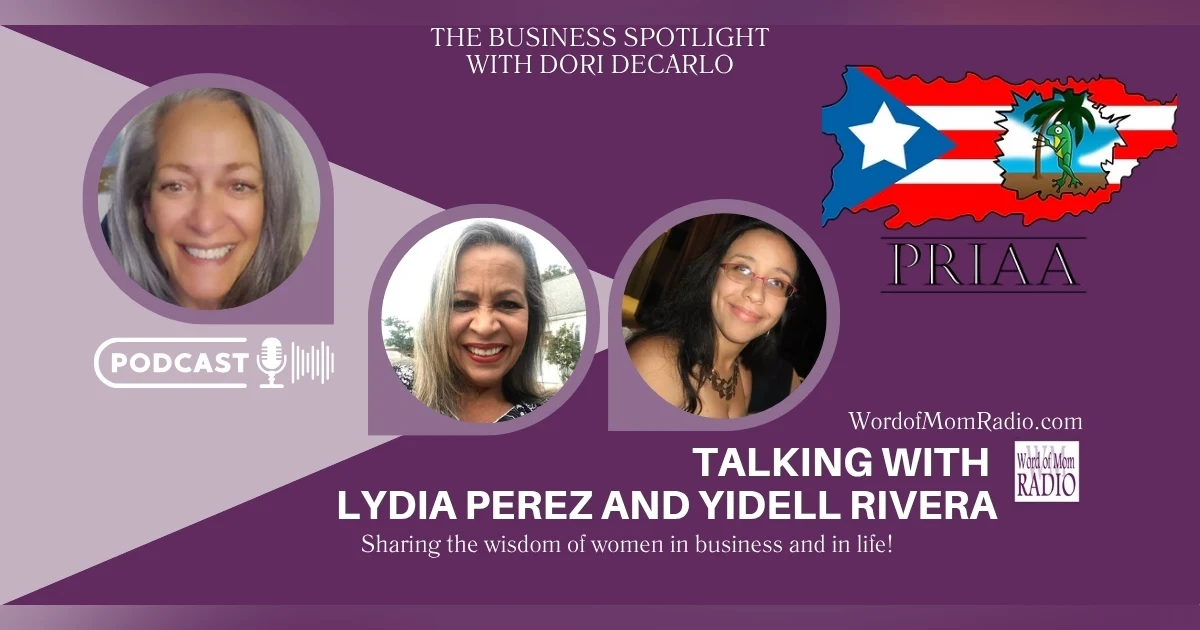

Lydia Perez says "If you're not familiar with Puerto Rico, we'll introduce you to it."
Lydia Perez is the founder and the Artistic director of The Puerto Rican Institute for Arts and Advocacy (PRIAA), based in Rhode Island and founded in 1994. The institute champions the gathering and retention of cultural memory, language, and identity transmitting these across generations in the form of education through the arts, not only for Puerto Ricans, but for all Latinos and for all Rhode Island.
Through the arduous 32 years of Afro-Puerto Rican career in Rhode Island and throughout New England, Lydia Pérez brings with her the Cultural Heritage Center, where all PRIAA social and cultural activities are developed for its members and for the Diaspora in Rhode Island.
Yidell Rivera, a devoted member of the PRIAA family since 2000, has played a vital role in shaping the organization's mission and vision as an Assistant for the Board of Directors and through her work as part of her Volunteer internship.
The Puerto Rican Institute for the Arts and Advocacy, Inc. (PRIAA) is a non-profit organization founded in October 1994 by Puerto Rican artist Lydia Pérez, an internationally renowned performance and folklore artist, dedicated to promoting and facilitate citizenship and cultural awareness of Puerto Rico through the music and the arts. On October 30, 2021, PRIAA opened its Cultural Heritage Center at Hope Artiste Village in Pawtucket to continue internships and promotion in our collaborative space.
Join host Dori DeCarlo on The Business Spotlight and connect with PRIAA at PRIAA-RI.org and follow on Instagram, Facebook, LinkedIn and YouTube.
Please support UnsilencedVoices.org a global 501(c)3 nonprofit that empowers survivors of domestic violence, sexual assault, and human trafficking. We thank Smith Sisters and the Sunday Drivers for our theme song, "She is You".
Be sure to connect with us on BlueSky, Facebook, Instagram, Twitter, and come tell us your story!
WordofMomRadio.com - sharing the wisdom of women, in business and in life.
Become a supporter of this podcast: https://www.spreaker.com/podcast/word-of-mom-radio--5252572/support.
0:00 She is sure, she is true, She is straw Istra, she is true, is true, she is Braise bray Is she is you. Hello, everyone, Welcome to today's Word of Mom Radio. Here on the Word of Mom Media Network. I'm your host, Dori Di Carlo. And you know we are here week after week breaking those myths that morepreneurs and business women, especially those of us building our businesses from home, that we're just dabbling in between bake sales and getting our nails done. We're not. We are smart, we are savvy, and we are sharing the wisdom of women in business and in life. And I am so excited to be bringing today's guests into Word of Mom Radio and having them share the amazing work that they are doing. In Rhode Island. Lydia Perez is the founder and artistic director of the Puerto Rican Institute.
0:57 For the Arts and Advocacy PRIA. As it is very well known and it's based in Rhode Island and founded in nineteen ninety four. Yadel Rivera is the administrative assistant to Priya and Lydia's daughter. So for me, as a monbradour, getting to see mother and daughter working together is always a joy. For me. Pria champions the gathering and retention of cultural memory, language and identity, transmitting needs across generations in the form of education through the arts, not only for Puerto Ricans, but for all Latinos and for all Rhode Island. As the founder and executive director of Priya, Lydia has an extensive record of promoting activities that increase cross cultural understanding, cultural awareness and self esteem of children and adults. Lydia has spent the last twenty nine years as a performer and cultural educator activist in the US, Cuba and Puerto Rico.
2:00 She is a presenter, singer, drummer, dancer, composer, poetry and artisan. She has been recognized as a community asset by many organizations in New England throughout the arduous thirty two years of Afro Puerto Rican career throughout New England. Lydia Perez brings with her the Cultural Heritage Center where all preasocial and cultural activities are developed for its members and for the dispora in Rhode Island. I could continue on, but I really want to bring these two amazing women into our shows. So Lydia and Yedell welcome to Word of mom Radio. Thank you very much to having me here with you.
2:42 Thank you very much for inviting a story. My pleasure, and I would love for you to take us on your journey Lydia and share how you came to develop Ria. Wow, that was long, long times ago. You're talking about every three years ago. So I started this with a birthday party with my friends. I just remember she invited me to be the happy birth of his son, and then I would go with my fan this is a tambourine, a small tambourine, and then I ain't seeing a song A happy birthday to you. With the rhythm of the plena, can you explain to her what is that?
3:24 Okay? So Blena is an Afro Puerto Rican traditional music. It's often called the sung newspaper because it's used as a medium a tool for gossip, or for social commentary, or just basically just saying the news, or because it was developed during a time on the island where the most common people couldn't read or write, so they couldn't read the newspapers. I was for the high nobility, for the landlords, not for the common folk who work the field, and so how they got their news around was through song, word of mouth through song, and what better way to go from town to town than carrying around little hand drums and making up cute little verses about oh yeah, this squan e though had a fight with Juliana and now he's living in the doghouse. Aha, isn't that funny type of thing. It's a cultural aspect that has been passed down through generations and it's a staple on the island, not just blenna, but also another genre called bomba, but that's we'll get into that later. But blenna is basically the more mobile and the type that you march and dance too. You would see it most commonly in festivals, in carnivals and parties, Like mom said at a birthday party where she used the hand drum and the rhythms of blenna to sing this little boy happy birthday, and
4:55 it was really cute. I guess it. This is flena. It's a wonderful way. I love that this began at a party for a child. Of course. Yeah, talk to us about Priya and who are its people well. Prea is a non profit organization dedicated to embrace our Puerto Rican and traditional and heritage of course, and then PRIA is three organizations that improved leadership through the arts. Then we started doing it with Apprentice. Always had to be with Apprentice. Because this is the way that we increase our community.
5:36 PRIA is the heart of the Puerto Rican community in Rhoe Island right now and it is known for everybody in regional and national leave. We are very proud of our work. It's amazing, it really is, and especially starting thirty three years ago where awareness. My mother is pht Rican, so you know Mayo Boilita, when it was funny, nothing angered her more. We're talking sixty years ago. When she would see a sign in Spanish, she would get angry about it. She really would, because. She was like, you know, I came to this country, I had to learn English. She would just go on and on and on and on and on.
6:18 And I grew up at a time where you didn't make your child bilingual. I should be trilingual because my other side of the family was from Italy, both my grandmothers, so my nanny and Mioita, and she would speak Italian, the other one would be speaking Spanish and their dialects because in Italy there's so many different dialects. But their dialect was so close that they would just be sitting there chatting away. We would laugh. But again, I love seeing the embracing of the culture and not the drowning out of the culture. So how have you been celebrating the differences as we all lived together?
6:59 How were of doing this? Well, it's funny you should actually mention that story about your grandma being angry at the Spanish science, because in our history, we've noticed that a lot of these immigrant and migrant families have been trying purposely to not neglect, but purposely deny their children teaching them Spanish or teaching them about their roots and history, thinking that it would be better for them if they were so Americanized, that they would integrate directly into the American people. We're advocating for the opposite. It closes so many doors when you do that. These families don't understand. Teach your kids Spanish, teach your kids your primary language, English is your secondary language in the situation. Teach your kids your roots, your heritage.
7:55 It opens up so many doors. Do not deny them their culture. These are the messages that we as an organization, we advocate. We are invited by the school administrations to go into the school systems and they have a small twenty thirty minute break field trip into the auditorium, take a break from their classes, and we get to teach them about our culture. We get to teach them about Lena, we get to teach them about Bomba, and at the same time we ask them, Hey, if your grandma or if your parents speak Spanish, ask them tell them that you want to learn. It's okay to be who you are. Don't deny it. This is an extremely important message that we have been pushing for these past thirty odd years.
8:42 Do not be afraid of who you are. It is not shameful. I love that, I really do. For those of you out there. The best way to teach your children, because they are little sponges, they will asure everything. One of you speak English, the other one speaks Spanish, and that way, one parent is communicating in English, but the other one is always communicating in Spanish, and the kids learned. To go back and forth and back and forth. It is the easiest way for. Them to learn both languages, because again, they are little sponges. My second language was sign language, so when I would give my kids a piece of bread, I would sign bread for them. My middle son was speech delayed, so I taught him to sign. He couldn't speak, and I used to tell him, you have to say it or you have to sign it, but you have to tell mommy what you want because I can't understand you. And his speech therapist, oh, well, of course he doesn't speak.
9:40 You taught him to sign. I looked at her. I said, wow, he supposed to communicate it exactly. Thank you. So that's when saying, you know what, the more you introduce your children to other languages, other cultures, it makes it part of their being and really does, and it's so important. We're talking about being in Rhode Island. Where are you in Rhode Island? And how far out does Pria reach? Hi? Who? We're located in Patucket, Rhode Island at ten zero five Main Street. How are you? By the way, Our doors are open to anyone who wants to come in and wants to learn, so please go ahead. I was saying that playfully, but yes, that is our address, ten zero five Main Street, Patucket's Sweet twenty two twenty eight. It's a big brick building. It's called Whole Artist Village and our reach Priya's reach. We've been able to Actually, for the past thirty odd years, it was us who traveled to them, not them coming to us. So we would be invited to cities such as Springfield, such as Boston, such as Portland, Maine. We went all the way down to Georgia, floridaa Virginia, as far north as New Ham, I'm sure Vermont, Maine. We traveled all of New England.
11:04 Mom herself has gone to San Antonio, Texas. She went to Cuba one time without man. I was a little mad, but it's fine. We traveled to where they invite us so we can spread our mission out to other people. It's only been recent within the last three years that we actually opened up our brick and mortar center here in Patucket. We were tired of traveling out, so we were like, okay, now it's time for the opposite. Now we sit here and now if people want to go and they come to us, yes, okay. And it's been beautiful, it's been great. Like I said, our doors are open, come come check us out.
11:44 So our commitment, our mission is the same. So we tried to. Reach our community, listen, to emerge, then to sense it of pride of their culture, identity, the language, and the same time acquire that, acquire the commitment to mainteen development and transmit that pride generational linings. I focused rush through. The arts and expiration to mainteen the heritage of the Puerto Rican population. We advocate for the respect with the service as American citizen who contribute to the social politica, economic and cultural well being on entire nations.
12:36 Yes, on that note, please think of what Lydia just said. Please think of what she just said about the citizens of the United States in Puerto Rico and what we are doing here in this country. Yes, we are going to take a very quick break to say thank you to our sponsors and we will be back here in just a moment. Onward of Mom Radio. She is brave, she is bold, she is you, and we want to tell your story. Are you ready to share your journey with us on Word of Mom Radio. Go to wordommradio dot com and register as a guest. We want to tell your story because when you win, we all win. And we're back here on Word of Mom Radio. We are talking with Lydia Perez and Idel Rivera from Priya, the Puerto Rican Institute for Arts and advocacy that is based in Pawtucket, Rhode Island. Now, Yes, at a wonderful place, Pope Artiste Village that is doing so much to reach out into the community and is developing such a wonderful I was there the other day.
13:47 The Latin quarter that you have now, it's so fabulous. So with that happening, you now have your carnival that is happening. And I want to talk about this because it is a week of amazing workshops going on that will culminate in this carnival on June twenty eighth. So talk to us about this and let everybody know all of the wonderful things going on. So, yes, carnival, where do we start? Okay, We're starting our carnival's week on June twenty fifth. From June twenty fifth to June twenty eighth, we are holding a carnival called La Pegenya Sanse the Roe Island Sansea. Sanse means the little Sanse, And what a Sanse is is that it is a shortened version of how to say Saint Sebastian.
14:46 So what it is is that the Carnival of Saint Sebastian is the largest carnival on Puerto Rico. It's held in January, and it is the carnival. When anybody outside of the island or think about the traditional or the typical Caribbean carnival, they usually think of either Marti Gras or those kind naval with the ladies with the feathers, or they think of our carnival, which is Fativa San Sebastian, the Festival of Saint Sebastian in Puerto Rico. It is huge. A lot of people just pile into the main street in San Juan, Puerto Rico actually named Saint Sebastian Street.
15:32 So what it is is that each city, each town in Puerto Rico has a patron saint that they that they pay homage to. And the patron saint of San Juan, the capital, is Saint Sebastian. He has a primary street in downtown or Old Sant Juan, which is where this festival takes place. And so what we're aiming for is that we are trying to take little bits and pieces of that festival, little pieces of our home, and bring it to you guys in Rhode Island in Patucket. Right here at the Oupartist village right outside of our little center, the Cultural Heritage Center, we are planning on throwing a mini version of that festival. So we have food vendors, we have music, we have dance. We have a big head kavasudo caricatures endemic to our culture. We have ahiganthas, which are the tricks to spirits that love to play pranks on people. We have poetry, we have every form of expression that you want to see in a carnival.
16:37 We're going to have it. Plus it's not just for Puerto Ricans, it's for everybody. Come along, we have fun. We also invited our other friends, our Dominican friends, our Brazilian friends, Peruvian friends, the Colombian friends, to everybody, to include everybody to have fun. So on Wednesday, June twenty five, we started with Behaganthi making workshop and that would be twelve noon to four and then we would jump to six thirty pm to eight pm with plan of music with the small tambourine and then introduction of the behigante alava.
17:20 Funny something like that. Then in June twenty sixth we will have a health tree exhibition. We will have a seedision of mess from Legacy High School trumpetok student from there was with us at three or four making mess, began mess, so they will be there. They will be with us, you know in the exhibition also the hard three that we have a four months with then doing the same introduction of our mess and Behegante and then all of that adapt day with exhibition.
18:01 On twenty six. Also on twenty seven. We will have a worship of leather restoration of our drums. No, you have to fix it because a long time, long time, you know, they need fixes. So we will have that worship also and the twenty seven we will have worship of Behiganatee Literature and storytellers and see Staring Taylor and that will be six thirty till eight and then we will have bombas and the big party will be in June twenty eight to celebrate the cannumber of all of our.
18:43 Past work with children and everything. That day will be in that moment would be in the sunsay La Pequina sunse. How long is the carnival from one to one on the twenty eighth. From noon to four pm. I really encourage you to go. Is going to be so much fun, So tell us about the bomba music. Bombamba job a bit of poetry there. What bomba is basically Black storytelling in verse with African drumming. So little tiny history lesson. Back during the days when the Caribbean islands were being colonized, they brought over the Africans to work the sugar cane fields as slaves, and they prohibited these slaves from communicating with each other basically just talking.
19:39 So what they decided to do was that in order to communicate between tribes, they would sneak in music. And so just like how we explained in Plena before, bomba precedes blena. So what it is is that they would use music as a disguise is to transmit messages through these celebrations that the masters would allow them to have, you know, after hours at night, during downtime. So what it is is that bomba is basically just storytelling and messages through music and dance, through music and art.
20:20 And then yeah, it's amazing how music can convey so much and how that is how these slaves were using this to communicate each other, to send messages. Yes, it's where just the power of music. And that has been passed down generationally from master to apprentice, from master to apprentice, and the Bomba music is so prevalent on the island that they have actual gatherings of Bomba masters and big festivals, big bombasos, they're called bombasos where it's a big celebration of Bomba music. Drummers from all over the island and come in and they don't compete, but they come to show off their skills because if you watch these masters at work, their hands drumming on those drums are works of art. Oh my goodness, the type of rhythms that they can produce, my goodness.
21:16 I'm so looking forward to this, I really am. What we are doing with the kids in Legacy High School and the Heart Treat Tribe is that we are teaching them how to make their own Vehaganta masks. So for the past three to four months we have been teaching them how to make their own masks out of paper mache, when traditionally they would be either made out of paper mache or out of coconut husks. The North uses coconuts, the South uses paper mache. We don't have coconuts here, so we were left with paper mache. But these kids are loving those lessons and talk about. The our Neil Behaganti and.
21:56 We do when we are debuting them in a carn. We have a friend, artist friend who's coming directly from Puerto Rico who has been developing new Vehan mask out of craft foam. So they are lighter, arier, and a lot more vibrant than the traditional paper mache are coconut masks. They're a lot lighter, they look adorable. I'm looking at them right now of ve from the town of Bons Bons. It is a town in the south of Puerto Rico. Remember what I say, the paper mache masks are made and they are characterized by these long paper mache looking horns and very ornate and this animal and they have a lot of animalistic features, whereas we have vehigant this from the north of Puerto Rico lois size. They're traditionally made out of coconut husks, so as you can see, it's emulating coconut husks and the horns are the coconut barbs.
23:01 He's an up and coming artist in Puerto. Rico named Ken Kenneth Melande and he has developed these tie off. Mass absolutely so as we are wrapping up what do you want to leave our listeners with and how may they reach out to you and feel free? If you want to leave this message in Spanish, okay okay, I would do. Both jokio in bitar at todo at too lahine. I would like to formally introduce all of the beautiful people of Patucka and Rhode Island and all your. Listeners perto Rico, perto Rico.
23:49 We invite you all to partake in our culture because if you guys can't go visit our island, we will more than gladly bring our islands traditions to you. Locate part trail Puerto Rico. And we are here to celebrate what it is popular arts, popular traditional heritage cultural arts of Puerto Rico. At Las Laco, Puerto Rico, mos. So, currently a cultural heritage center, we feature five most popular traditional arts from Puerto Rico, which are Santos de Paloo and Madeira Wooden saint carvings. It is a lost art from the island. It has lost all religious iconography.
24:48 What it is is that each house used to have their own wooden saints that they would pay homage to. But when the island turned Protestant, they were all considered heresy and so they were all or to be burned and destroyed. Very very few of these wooden saints actually survive to this day and they have become collectors' items. And so what we're doing is that with the help of master artisans from Puerto Rico and from here in New England, we are reviving the art of recreating these carved wooden saints and what they used to represent. Is La Mosica Bomba.
25:31 And two. More of the popular arts that we offer and teach are how to play and dance because it is a dance bomba and polena with both are they're they're tied together, but there are separate genres of music. Lass. The art number four is creating these carnival masses ve or carnival. We teach you from start to finish how to create your own. Carnival mask laliter and iso.
26:13 And along with the Vehanta mask, we also teach Vehganta storytelling and literature, so that way these kids can learn how to speak and write Spanish in their own terms using vehigantas. As a medium, Dtros infantile. And Lonino bilando. And along with the those literatures, we also encourage them to create their own theater, their own little dramatization plays that they can do themselves. They can storytell with each other and their peers. Oh but.
27:05 So these are the popular arts that we offer to our patrons, the people of Pentucke, the people of Rhode Island. Anybody who come in comes in through these doors. They're more than welcome to learn from us our cultures and traditions, because they should not be gate keyed. Being Inla Sanse. So what is really important for us to say right now? We would like to officially thank our sponsors and collaborators, So Central Falls Mayor the Honorable Maria Rivera for accommodating our needs. Hope Artist Village for housing us. Thank you very much for giving us the space to open up our doors. American News is also one of our collaborators and sponsors and a long time, long time, thirty odd years we started out with America News. Oh my goodness. Hi, Enfonso Segue Legacy Charter High School. The Heart Tree Tribe is another one village theater right next door. Our fellow thomaturgis in the Arts New England, Latino Arts right next door.
28:19 National Endowment for the arts. Of course, we're facilitating the grants that we may not we would not survive without these grants. To thank you so so much, and of course we would like to officially reach a warm heartfeld thank you to the City of Pawtucket and to the Department of Treasury for making all of this possible. Thank you guys so much. This is our collaborator and our sponsors. You may visit our website at www dot p r i AA Dashuri dot org. So that's Predauri dot org.
29:02 All of the links for Priya are going to be live onwardif momradio dot com. I really encourage you, if you are in the area, go to this carnival, take some of these workshops. There is so much beautiful heritage being shared by these two amazing women that are out there advocating for the history and culture that we love. So you know what, gracias jode kido mucho. I'd thank you, and for all of you tuning in, thank you so much for being here. We're going to close out with our fabulous theme song from Smith's Sisters and the Sunday Drivers.
29:50 So till next time. This is Dori di Carlo saying, go out and create a marvelous youth. Bye for now. She is sure, she is sure, she is strong, she is strong, she is true, is true, she is braise, she is she is you, is you, she is, she is sure, she is she is strong, is strong, she is true, she is true, she is braised, she is bold, she. She is you, she is she is. Sure of herself. Yeah, she takes care of his powerful and strong. Yes, she knows who she is has integrity, woman, strong and true. You know her by name. See this woman is you. She is sure, she is strong, is strong, she is true, is true, she is brave, she is she is, she is you, she is she is, she is sure, she is strong, is strong, she is true, is true, she is brave, she is she is she, she is you, she is you. She is adds value and hope. Has proved to be brave. See it's never too late, never time to behave reaching for dreams doesn't matter.
31:11 The age believes in herself, unleash from her cage. She is sure, she is sure, she is strong, is strong, she is true, is true, she is brave, she is bold, she is you, she is she is, she is sure, she is she is strong, she is strong. She is true, is true. She is brave, brave, she is she is you.

Founder/Program Director
The Puerto Rican Institute for the Arts and Advocacy, Inc., (PRIAA) is dedicated to promoting civic and cultural awareness services for the Puerto Rican in Rhode Island.
(PRIAA) runs Caribbean Arts programs in the community and in education. We are a creative performing arts organization, and as an integrated arts and academic facility, we have nurtured future 21st century leaders.
Our Cultural Heritage Center is a new space available for teaching, learning, and cultural exchange in Rhode Island.
PRIAA has held traditional Puerto Rican festivals in Central Falls, Woonsocket, and Providence. These festivals are known in Puerto Rico as "Fiestas de Pueblo". According to the 1996 Rhode Island Monthly Magazine, p. 31. refer to us and we quote: "It was more than a festival, it was" a meeting in which the Puerto Rican and Latino communities merged".
Since 1996 PRIAA have collaborated with great leaders in the Puerto Rican and other ethnicity Community. Now, we have brought our Fiesta de Pueblo under the Caribbean Arts program for Education throughout New England.
PRIAA works to advocate for the Puerto Rican community. Our goal is to reach out to our Puerto Rican communities to keep and maintain a sense of pride in their cultural identity and language, and to demonstrate the importance of maintaining that intergenerational pride. We use the arts as our main tool to maintain the preservation of Puerto Rican culture in our state and others state in Nationwide. We advocate for our Puerto Ricans as Americans and maintain the respect we dese… Read More