
 Spotify

 iHeartRadio

 Amazon Music

 Apple Podcasts

 Pandora

 Youtube Music

 PlayerFM

 Overcast

 PocketCasts

 Goodpods

 Podyssey

 Audible

 Podchaser

 RSS Feed
Liz Steblay on The Authors Alley with Dori DeCarlo
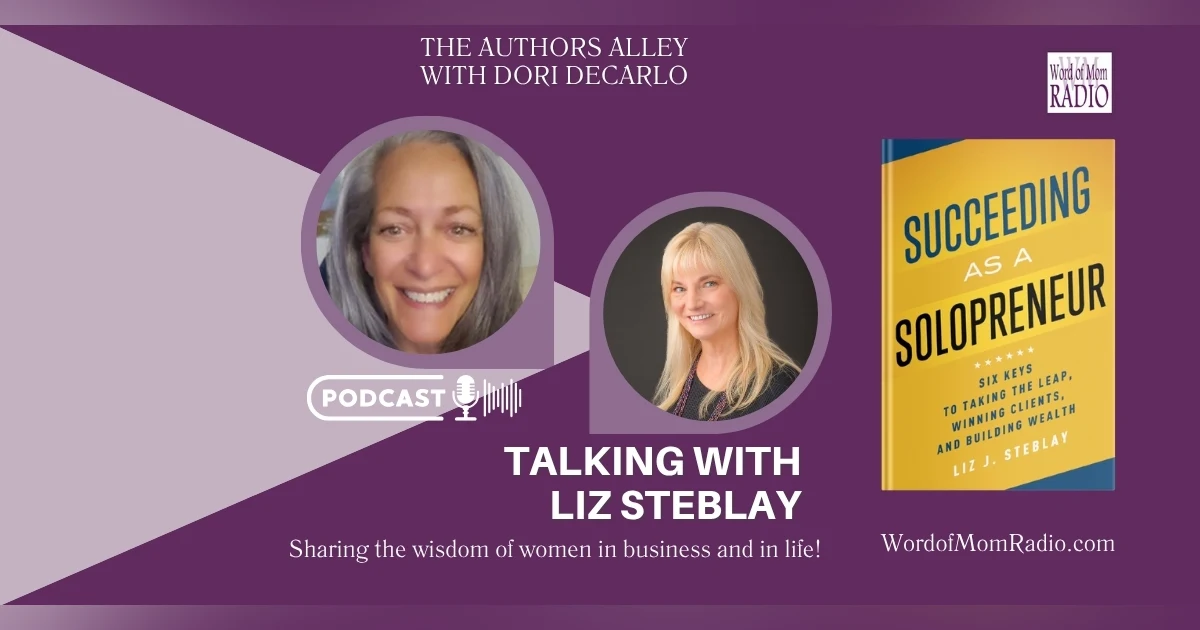
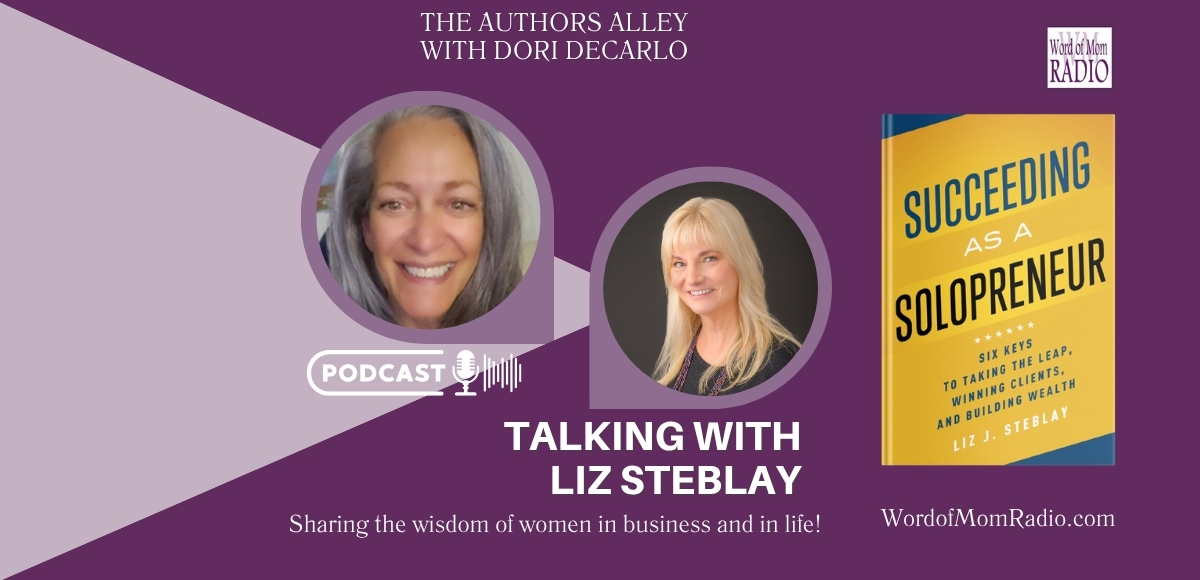
Liz Steblay wrote Succeeding as a Solopreneur for current and aspiring solopreneurs to help you master the critical steps for achieving success at every stage of your solopreneur journey.
Liz Steblay became a solopreneur before the word was even invented. Upon being laid off, she called a former colleague, and a week later she had her first consulting contract. After that first project, she realized that she made more money, worked fewer hours, and had more time with her daughter. She never considered another “real job,” despite being a single mom in an expensive city.
Five years later she founded the ProKo Agency, which represents independent consultants on projects with Fortune 500 clients. As a result of growing ProKo into a national business, Liz has become known as the person to call if you have questions about self-employment.
In 2018 she launched Professional Independent Consultants of America (PICA), an educational organization and community that helps people start and grow their own solo businesses.
She’s the author of the book, "𝗦𝗨𝗖𝗖𝗘𝗘𝗗𝗜𝗡𝗚 𝗔𝗦 𝗔 𝗦𝗢𝗟𝗢𝗣𝗥𝗘𝗡𝗘𝗨𝗥: Six Keys to Taking the Leap, Winning Clients, and Building Wealth", the ongoing blog "Successful Independent Consulting" as well as articles on Inc.com. The only daughter of an entrepreneur, Liz always knew she wanted to run a business, but her true calling is to teach others how to launch and grow theirs.
Join host Dori DeCarlo on The Authors Alley and connect with Liz at SixKeys.info and on LinkedIn.
Please support UnsilencedVoices.org a global 501(c)3 nonprofit that empowers survivors of domestic violence, sexual assault, and human trafficking.
We thank Smith Sisters and the Sunday Drivers for our theme song, "She is You".
Be sure to connect with us on BlueSky, Facebook, Instagram, and come tell us your story!
WordofMomRadio.com - sharing the wisdom of women, in business and in life.
Become a supporter of this podcast: https://www.spreaker.com/podcast/word-of-mom-radio--5252572/support.
0:00 She is sure, she is true, she is straw is straw, She is true, is true, she is praise, pray, she is she is you. Hello, everyone, welcome to today's Word of Mom Radio. Here on the Word of Mom Media Network. I'm your host, Dori Di Carlo. And you know we are here week after week, show after show, breaking those myths that mompreneurs and business women, especially those of us building our businesses from home, that we're just dabbling in between bake sales and getting our nails done. We're not. We are smart, we are savvy, and we are sharing the wisdom of women in business and in life. And I am looking forward to bringing today's guest into our author's Ali Liz Stebbi became a solopreneur before the word was even invented.
0:51 Upon being laid off, she called a former colleague and a week later she had her first consulting contract. After that first project, she realized that she made more money, worked fewer hours, and had more time with her daughter. She never considered another quote unquote real job, despite being a single mom. Five years later, she founded the pro Coagency, which represents independent consultants on projects. With fortune five hundred clients. She is the author of the book Succeeding as a Solopreneur Six Keys to taking the Leap, winning clients, and building wealth, the ongoing blog Successful Independent Consulting, as well as articles on inc dot com. The only daughter of an entrepreneur, Liz always knew she wanted to run a business, but her true calling is to teach others how to launch and grow theirs. And with all that being said, Liz, welcome to Word of Mom Radio.
2:02 Thank you. I'm excited to be here because I'm a big champion of moms being self employed so they can run their life the way they want. Well, you know what, as somebody who's been calling myself a mompreneur since nineteen ninety four, I know what it is to be calling yourself something that nobody had heard before. So I would love for you to share how a solopreneur is different from an entrepreneur and why not difference matters. So the term solopreneur probably started working its way into our lexicon about eight years ago. I've been solopreneur for over twenty so long before the word was invented. As you said, the key difference is that you don't have employees, and you don't want employees. So solopreneurs are all about doing the work that they love and making a good living and not necessarily growing it to be some thing bigger than just themselves. So we may have subcontractors or people who help us with our business on a part time basis, but we don't have full time employees.
3:11 Usually. The other major distinction is we're not selling a product, usually as some sort of a knowledge service like executive coaching, life coaching, interior design, financial planning, or of course independent consulting. Interesting, I didn't think of it that way. I mean as somebody who did have a product, yes, at one point, as a solopreneur, and then eventually, you know, grew a business where I actually had people working with us, and then COVID happened, you know, and as a lot of people you have to step back at sometimes I want to talk about in your book because you really do make it very easy in what you discuss. How you're explaining things as that solopreneur, whether you are as you were saying, consulting, making sure that you're not being referred to as attempt and things like that. You know, how do you go about creating that solopreneurship, give us that little ground up start.
4:25 Yeah, well, obviously I wrote a book about it, so I'm not sure I can cover it in the next twenty minutes, but basically it's there. There's three main chunks to being successful as a solopreneur. One is marketing, the second is business development, and the third is running your business and paying less tax. So in terms of marketing, the part that people struggle with the most is developing a very clear niche for their services. And what do I mean by niche? It means like, Okay, you can be an into consultant, but what type of consultant, management consultant, technology consultant. Lots of different types of consulting, so you need to have a niche. For example, I was an independent consultant who did organizational change strategy and implementation for Fortune five hundred companies. So I had a specific area that I was a special that I had expertise in and I served a particular part of the market. A lot of people make the mistake of thinking that they need to go to market as a jack of all trades, or in your audience's case, a jill of all skills.
5:39 But the reverse is true, because if you put yourself in your client's shoes, they want to hire somebody that's an expert, not somebody who's maybe done it before or can probably figure it out. If they're going to be especially in consulting, if they're going to be spending tens of thousands of dollars, they want to hire the person who's the expert in the particular in a particular niche. So that's why and niches so important. The second reason it's so important is because most solopreneurs get their business through referrals. And if you're going to market as a laundry list of skills without a particular niche, it makes you, It dilutes your your marketing, it makes you very difficult to remember. So that's why having a niche is so important.
6:19 I talk about how to figure that out in the book, and that little piece of that tied to that is how to develop your tagline. So what are the few key words that you want to be associated with to pop into people's minds? For example, I no longer do independent consulting myself. Now I'm all about solopreneur success. So solopreneur success are my two key words. So when anybody hears the word solopreneur, I want my name to pop into their minds. And so there's another whole chapter in the book and some exercises for help to help people develop that as well. It's funny with word of mom, it was sharing the wisdom of women, and then we in business and in life.
7:02 Just as a further explanation, but on our business cards and our banners and things like that, it's just always sharing the wisdom of women. And again some people will why because men don't have wisdom. We get to hear from men all the time. Yes, but. If you're trying to appeal to everybody, you're not really appealing to anybody. There you go. It's true. It really is. One of the things that you talked about and I really like in the book is talking because I think very often when you start a new business in a service, you don't know what to charge, you don't know how to promote a package, You worry about charging too much. I would love for you to kind of talk a little bit about what you share in the book because it's really good.
7:52 Thank you. That's another key to successess, It's one of the six keys to success is charging what you're worth. And I would say the single biggest mistake that I see people make when they step into self employment is they don't charge enough. They under charge and it's it's difficult to stack up your spine and say I charge five hundred dollars an hour. But there are ways to come up with what your billing rate should be that enable you to sit up straight and say your quote your rate with confidence. There's different exercises in the book for how to figure out what your hourly base rate should be and then how to adapt that whether it's a per project fee or a hybrid type of situation where part of it's a fixed V and part of it's by the hour. So although that's in the book, but the most important thing to remember about setting a price and quoting a price is that the confidence is everything.
8:51 So in that actually have two businesses, but the one that you mentioned and when you introduced me, the pro coagency we placed. We were asked by a medical device company for a recommendation for a consultant to develop a leadership development program. We put forward four consultants. They all were amazing twenty years of experience fortune five hundred or consulting backgrounds, et cetera. Three of them had billing rates around three hundred to three fifty an hour. The fourth person was eight hundred dollars an hour, and we coached her. We said, you're the outlier. You're a lot more expensive than any of the others. Do you want to adjust your rate? She says, nope, this is what my clients pay and this is what I want to go in with.
9:35 So when we pitched the consultants to the client, we didn't list the rates. We said, the rates range from three hundred an hour to eight hundred hour. We're not going to tell you who's charging what. Of course, long story short, they hired the woman eight hundred dollars an hour. She was no more qualified than any of the other three, but she had the courage and the backbone to stand up and say, no, that's what I'm worth, that's what people pay. So I hope people remember this story that, Okay, yeah, there is competition out there, but sometimes it's a matter of confidence. I think Peka is doing a really good job with that. One of the things that's stuck with me was the person who was two hundred dollars an hour, and they asked if they would do one ninety. And you gave the example of how when you look, yeah, it only sounds like ten dollars, but when you look over the life of the project that was nine months long, it was six thousand dollars less. Yes, And that was because again we do we go into that how it's only ten dollars. You have to look at the life of the project and then really see what it is. And you know what, more often than not, when you don't come down in your price, people respect that. Yes they did.
10:56 And one of my favorite tricks that I have from coach people about is to say, uh, is to open up just a word document and put up at the top this says pricing policy, and then write the phrase we or I do not discount my rates. We do not discount our prices, and then you close the document. So now when a client asks you to discount your rates, you can say, well, it's my policy not to discount rates. Does anybody ever ask to see the policy? No, But by saying those magic words it's my policy, it makes it non negotiable. It's a matter of business. I also like that you had a range in there depending on the scope and the magnitude of the project, so anywhere between you know, one hundred and ninety five and two hundred and fifty dollars an hour, depending again on the scope, on the length you mentioned. If it's a longer project, you might give them a little bit of a lower rate and things, but the rate may go up when you really look at the scope of the project and everything else. And it's funny. One of the things that we always share is it's like buying a car. You have to be willing to walk away.
12:09 Yes, yes, you have to be willing to walk away. But you're right about quoting a range. That's based on principle and psychology you called the center stage effect. It's been well documented that when people are given a range, they gravitate towards the middle. If people are given in fun choices, they gravitate towards the middle. And so by quoting a range, the price will nearly always gravitate towards the middle. And so make sure whatever range that you quote, the number in the middle is what you really are hoping to get. So, for example, I used to save my rate range is from one seventy five to twenty five an hour based on the scope, duration, and complexity of the work. Well, no client in fifteen years ever tried to push me towards the bottom end of that range, not once. They were always felt like their situation was more complex, or if it wasn't complex, why are they hiring you as an outside talent, et cetera. And I was always happy getting abount two hundred dollars an hour.
13:04 There was one time, though, that I did not quote the range, and I just went straight to the top. And that was because I could sense the client's sense of urgency. This guy was just sweating in the meeting. I said, I bet you got people coming buy your office three times a week saying am I going to get laid off? What's going to happen to my team? And he looked at me like I was walking on water and he said, how do you know that? And I said, because I've done this type of work for the last eight years, and if you haven't answered this question directly, this is on their mind. He says, you understand our situation, so well, how soon can you know what do you charge? And I said, well, listen, you're behind the eight ball here. You haven't done any of the work that you should have been doing up to this point. I can start next week and do an assessment, will take three weeks, and I charged two twenty five an hour. He says, great, let's start on Monday. All right.
13:56 Sounds like a great story. Because I got the high end of my range in retrospect. I could charge to fifty to seventy five if I had gone through my normal process of Tip number one, don't quoterrate in a meeting. Tell them you're going to send him a proposal the next day, and that gives you the time to think about all the factors that impact rates, like what's their sense of urgency, what industry are you in. This was a medical device company. They were hugely not sensitive to price because their margins are to enormous, so they had tons of money. Also, they had a large consulting firm in there doing the technology work. And I'm familiar with large consulting firms. Charge any fact quoted any number less than three hundred dollars an hour. I was going to appear like a bargain to this guy. But I didn't go through all of that. So learn from my mistake and don't quot rate in the meeting, consider all the factors and then follow up with the proposal.
14:52 On that note, think of what Liz just said, because let's face it, we always want to give our price right then and there, don't. We'll be taking a quick break, say thank you to our sponsors, and we'll be back here in just a moment. On Word of Mom Radio. She is brave, she is bold, she is you, and we want to tell your story. Are you ready to share your journey with us on Word of Mom Radio? Go to wordomomradio dot com and register as a guest. We want to tell your story because when you win, we all win. In twenty seventeen, Unsilenced Voices was formed to help survivors of domestic abuse and gender based violence worldwide. The organization currently serves Siri Leone, Rwanda, Ghana, and the USA. In twenty twenty two, Unsilenced Voices gifted over thirty three thousand dollars to survivors in the USA and in Siri Leone.
15:55 There are over twenty six young girls who have been rescued from second trafficking and domestic abuse and now going through vocational training school in order to better their lives. We need your help. Donations are critical in order for us to continue our work. We also need volunteers to help with research and development. Please visit Unsilenced Voices dot org for more information. And we're back here on Word of Mom Radio. We are talking with Liz Stebley, who is the founder of the PROC Agency and PIKA, which is the Professional Independent Consultants of America. All right, now, I'm going to pick your brain. What are some of the biggest mistakes you see people make when they're setting up their own business.
16:49 Well, we already covered the biggest one, which is under charging, so yes, you have to charge what you're worth. I'd say that another big mistake is getting in your own way, which again ties to the confidence piece. Business development is a big part of being self employed. You have to find your own work and this is where a lot of people get in their own way. They get in their heads. Well, I don't know how to do sales, I don't know how to do business development. I'm not comfortable reaching out to people. I'm not comfortable cold calling. Well neither am I. And I've been self employed for twenty years and I swear to this day I've never done any sales. Business development is called business development because it's about developing relationships. And my favorite blog that I've ever written that I don't know nearly one hundred blogs I've written now, it's business development equals relationship development. If you look up the definition of business development, you don't see the word sales. But people get in their own heads and they're like, oh, nobody's going to want to hear from me, or I haven't reached out to that person in five years, or I don't know what to say.
18:01 You got to get past that and building a relationship with somebody. Is the reason why this is so important when you're self employed is people are going to hire a solopreneur that is credible, so you have to have the expertise and who they trust and trust is not going to happen overnight. It's not going to happen by somebody reading your website. It's going to happen through conversations. I just was just last month I published the blog that your single best marketing tool is a conversation, because then you can ask them questions, you can learn about their situation, and you can show them how collaborative you are by asking questions by listening, by thinking and responding slowly and not trying to take over the conversation. So business development is one of the things that people struggle with, and one of the mistakes they make is they don't do it. They just don't do it because they're afraid.
19:01 The general in consulting, the general rule of thumb is that you should spend twenty percent of your time doing business development. I know thousands and thousands of self employed consultants, and nobody spends eight hours a week, one day a week doing business development. They just don't. However, if you spend even one hour a week doing outreach, I call it outreach. I don't even call it business development. You're going to be light years ahead of everybody else out there. And what do I mean by outreach. It means reconnecting with people, having a virtual coffee with somebody. I'm a big fan of virtual having a virtual cup of tea or a virtual cocktail, depending on the type of time of day, thirty minutes, bring your own beverage and let's just see what's going on with you, with life, with your kids and develop that relationship. Another way of doing outreach is to connect with people on LinkedIn, not just like the normal congrats on your promotion, but comment on their posts or provide them with something insightful like Dory.
19:58 I know you're really into to moentrepreneurs that came across this article in Allure magazine. I think you're really gonna like this, provide some sort of value and just keep in touch and keep your name top of mind. That's simple to do. I like that you were talking about LinkedIn because LinkedIn to me has always been your professional calling card. Yes, that's your online business card. And I like how you break it all down into what photo you're using, your background photo. You're about information, recommendations, all of the different things that you have to do on LinkedIn to give yourself that professional look.
20:42 Yes, I call it your storefront window because if you do a Google search on your own name, I guaranteed your LinkedIn profile will be one of the top three results, and people are more likely to go there than they are your own website. So it is your storefront window. So if you were a retail store, you would put your best merchandise on the mannequins in the window because you want to draw people into your store. Your LinkedIn profile is the same way you got to put your best merchandise right up there upfront to draw people into your store, and your store is a conversation, which brings this full circle to what I just mentioned before. You have to have a conversation. Nobody hires a solopreneur without first having a conversation.
21:25 Absolutely. You know. You also said one of the six keys to success is paying less taxes to keep more of what you earn. And you give a bunch of tips in this in your book. You want to give us a couple. Yes, I am very much into paying less tax That's one of my favorite hashtakes. Pay less tax because as when you're self employed, you can lower your effective TAXIC much more effectively than your Canada as an employee. And you can save a lot more for retirement too than a traditional four oh and K. So I was just having this conversation earlier today about this. So yes, you need to contribute to your own retirement account, which is the limits are often way higher than they are for a traditional four one K, and that money that you put away to your retirement account lowers your effective tax rate that very that year. So let's say you made two hundred thousand dollars. You put twenty thousand dollars into your set IRA, you're only going to pay tax on one hundred and eighty thousand. So that's one of the one of the most important pieces. The other, which is underutilized, is a health savings account an HSSAY different than a flexible spending account, and HSA you do not have to use the money every year it grows tax You put it in that tax free because it lowers your effective tax rate. Like a regular retirement account. It grows tax free, and your withsoals are tax free. It's the triple play of tax savings. And even though the limits are low,
22:58 I think for an individual the annual amount is fifty five hundred dollars. You can invest it in almost any way you want and it will grow tax deferred, and when you take it out in retirement, it's it's tax free. So that's that's another key thing. And of course business owner expenses that's the other one. Absolutely, And going in on a ten ninety nine as a consultant, if you get a W two, it makes you an employee, yes, as opposed to taking it as a ten ninety nine you're an adympadic contractor, as a solopreneur, as a consultant, coming in whatever you're doing, and that way you can deduct your mileage, your website, your office, you know, if you're home, yeah, exactly, if you work from home, whatever percentage of your home and electricity and internet and all of these different things. There are a lot of things as a solopreneur, as a business owner when you're ten ninety nine in your clients that work to your advance.
24:01 Yes, I'm such a huge fan of the story that I've actually trademarked the phrase friends don't let friends w two. I like that phrase too. I remember from the book you know what, Liz, There is so much in this book, and it's an easy read. I really recommend this book is it's an easy read. It is laid out very well. The chapters are really well laid out and something that you're looking for, even just the chapter on LinkedIn, it's its own chapter. All of these things ten ninety nine ing, there you go, it's right there, and all of the different deductions that you can take. You've done a really good job taking your expertise and sharing it. So as we're wrapping up, what do you want to leave our listeners with Liz and how may they reach out to you?
24:52 Two things. One is the landing page for the book, and from there you can find out more about me either one of my bis, since it is a professional independent consults of America, et cetera. So the one you url to remember if you're listening to this while you're jogging or driving is six keys dot info, not dot com because I was way too expensive and I'm all about to keep keeping expenses low. So six keys dot info. You can either do it six keys or the numerals six keys, but six keys dot info is the one you are l to remember. The other thing that I will I am happy to offer is I do free one on one mini mentoring sessions. They're fifteen minutes long and it's amazing what you can what you can get in fifteen minutes. I usually leave people with at least three pieces of homework, and the way to find those is to go to PICA network dot org slash one to one, and that's actually the number one to number one.
25:52 All of those links are going to be live. And what do you want to say to that person out there, Liz who's thinking about starting that business as a solopreneur. You can do it. You don't have to do it alone. Just because it's called independent consulting or solopreneurship doesn't mean you have to do it alone. Now there's the communities like PIKA, the Professional Independent Consults of America. I just mentioned that I do free one on ones. There's the book, there's resources out there. The only thing that's probably holding you back is your own fear, your own fear, uncertainty and doubt. And all you need to know is that if you're smart enough to figure it out, you're smart enough to be self employed.
26:33 I am right there with you as somebody nineteen ninety four, I've been a morepreneur long before anybody knew. What that was. It is the best thing in the world, it really is. And I can't say enough that. You know what, if you haven't started yet and you're wondering when it's time, it's time, it's time, go for it. So, Liz, thank you so much for taking the time to come and share with us onward of mom Radio. I really appreciate it. I really recommend your book. It was a good read and had wonderful, wonderful information in a way where you don't feel like you're being infoloaded.
27:16 Good, thank you, congratulations, thank you. I'm all about practical advice. It was great, So again, thanks so much for taking your time to be here. I really appreciate it. Thank you, my pleasure, and for all of you tuning in, thank you so much for being here. We're going to close out with our fabulous theme song from Smith's Sisters and the Sunday Drivers. So till next time. This is Dori di Carlo saying, go out and create a marvelous you. Bye for now. She is sure, she is sure, she is strong, she is she is true, is true, she is brave, she is you. She is she is sure, she is sure.
28:03 She is strong, she is strong, she is true, she is true, she is brave, she is bold, she is she is you. She is she is she is sure of herself. Yes, she takes care of it. Powerful and strong. Yes, she knows who she is has integrity, woman, strong and true. You know her by name. See this woman is you. She is sure, she is strong, is strong, she is true, is true, she is braise, she is bold, she is she is you. She is you. She is she is sure. She is strong, is strong, she is true, is true, she is brave, She is both. She is she is you.
28:50 She is you. She is adds value and hope. Has proved to be brave. See it's never too late, never time to behave Reaching for dreams doesn't matter. The age believes in herself. Hunleash from her cage. She is sure, she is sure, she is strong, is strong, she is true, is true, she is brave, she is bold, she is you. She is she, she is sure, she is she is strong, she is strong, she is true, is true, she is brave, she is she is you.

Liz Steblay became a solopreneur before the word was even invented. Upon being laid off, she called a former colleague, and a week later she had her first consulting contract. After that first project, she realized that she made more money, worked fewer hours, and had more time with her daughter. She never considered another “real job,” despite being a single mom in an expensive city.
Five years later she founded the ProKo Agency, which represents independent consultants on projects with Fortune 500 clients. As a result of growing ProKo into a national business, Liz has become known as the person to call if you have questions about self-employment. In 2018 she launched Professional Independent Consultants of America (PICA), an educational organization and community that helps people start and grow their own solo businesses.
Liz earned her Bachelor’s degree and MBA from the University of Southern California. She’s the author of the book, "𝗦𝗨𝗖𝗖𝗘𝗘𝗗𝗜𝗡𝗚 𝗔𝗦 𝗔 𝗦𝗢𝗟𝗢𝗣𝗥𝗘𝗡𝗘𝗨𝗥: Six Keys to Taking the Leap, Winning Clients, and Building Wealth", the ongoing blog "Successful Independent Consulting" as well as articles on Inc.com. When not working she enjoys travelling, skiing, golfing, and riding her Ducati motorcycle.
The only daughter of an entrepreneur, Liz always knew she wanted to run a business, but her true calling is to teach others how to launch and grow theirs.