

 Spotify

 iHeartRadio

 Amazon Music

 Apple Podcasts

 Pandora

 Youtube Music

 PlayerFM

 Overcast

 PocketCasts

 Goodpods

 Podyssey

 Audible

 Podchaser

 RSS Feed
Kelly Tuttle on The Authors Alley with Dori DeCarlo

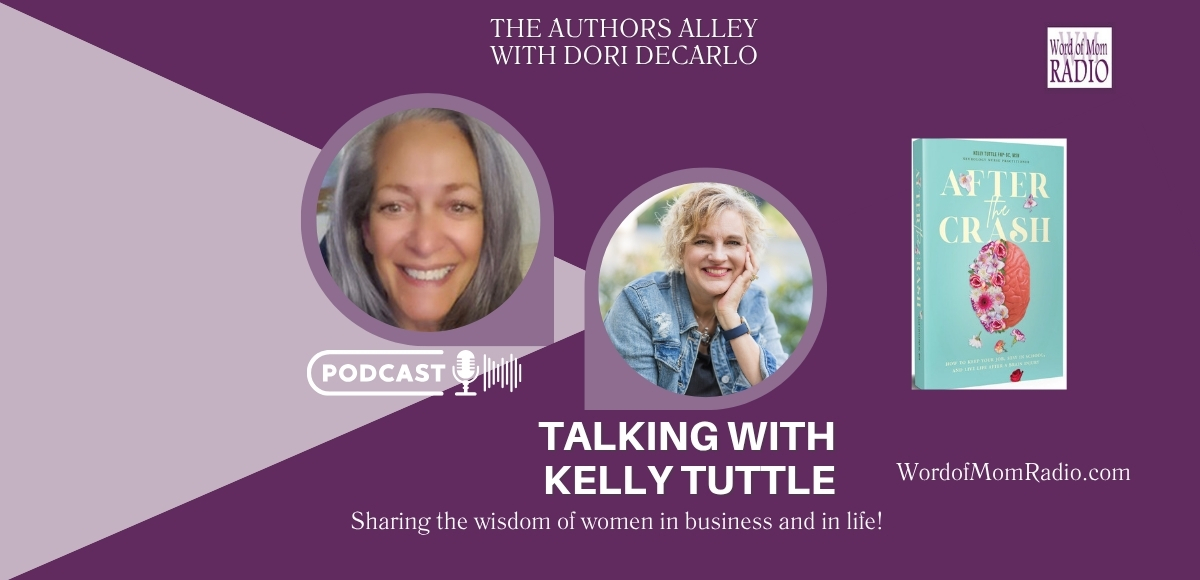
Kelly Tuttle is passionate about sharing her hard-won wisdom to empower others to overcome their own TBI struggles.
Kelly Tuttle joined the “head injury survivors club” (as she described it) in 2015, the night another car pulled in front of her as she was driving. It wasn’t until three months later that she realized something was seriously wrong. Kelly’s traumatic brain injury (TBI) marked the beginning of a new life and personal journey of self-rediscovery.
A neurology nurse practitioner, Kelly has a front-row seat to observe patients struggling with many of the same things she experienced in her recovery. She strives to share her coping strategies and tools and help them continue to work and study while they heal. Kelly also wants TBI patients to know there is hope. She got better, and they can too.
If you’ve survived a TBI and plan to continue working and studying despite daily emotional, physical, and cognitive challenges, After the Crash is a must-read. Get it today, and begin to understand your new brain and learn to love the new person you’re becoming.
Join host Dori DeCarlo on The Authors Alley and connect with Kelly at KellyTuttle.org. Be sure to follow on LinkedIn, Instagram, Facebook, TikTok, BlueSky and YouTube and become part of Kelly’s tribe!
Please support UnsilencedVoices.org a global 501(c)3 nonprofit that empowers survivors of domestic violence, sexual assault, and human trafficking.
We thank Smith Sisters and the Sunday Drivers for our theme song, "She is You".
Be sure to connect with us come tell us your story!
WordofMomRadio.com - sharing the wisdom of women, in business and in life.
Become a supporter of this podcast: https://www.spreaker.com/podcast/word-of-mom-radio--5252572/support.
0:00 She is sure, she is true, She is straw. She is straw, She is true, is true, she is praise, prayche is p she is you. Hello, everyone, welcome to today's Word of Mom Radio. Here on the Word of Mom Media Network. I'm your host, dory T Carlo, and you know we are here week after week, show after show, breaking those myths at morepreneurs and business women, especially those of us building our businesses from home that were just dabbling in between bake sales and getting our nails done. We're not. We are smart, we are savvy, and we are sharing the wisdom of women in business and in life. And I'm looking forward to bringing today's guest into our author's ali. Kelly Tuttle joined the Head Injury Survivors Club, as she described it, in twenty fifteen, the night another car pulled in front of her as she was driving. It wasn't until three months later that she realized something was seriously wrong. Kelly's traumatic brain injury TBI, as you've heard it referred to, marked the beginning of a new life and a personal journey of self rediscovery. A neurology nurse practitioner, Kelly has a front row seat to observe patients struggling with many of the same things she experienced in her recovery. She strives to share her coping strategies and tools and help them to continue the work and study while they heal.
1:34 Kelly also wants TBI patients to know that there is hope. She got better and they can too, And she and I talked about it before the show began. I've actually had six whiplashes and four concussions, so her book resonated very much with me. So with all that being said, Kelly, welcome to Word of Mom Radio. Well, thank you for having me Dory. It is my pleasure and I would love for you to take us on your journey that led you to writing your book. So my story begins with a thunderous clap of metal and the shattering of glass. I was driving home on a rural road when another car pulled out in front of me and I t boned the car. And I thought that even though it was a pretty bad car accident, that I would get better and get back into life, just shake it off, and I went to work the next day. But my nursing colleagues noticed that my behavior was different and I wasn't speaking right, so they pressured me to follow up with my primary care doctor the next day, which I did and was diagnosed with a concussion and taking off work for two weeks, and left with the feeling that I'd be better after two weeks, so I went back to work, was working forty plus hours a week, a mom an hour away commute and one About two and a half to three months later,
3:04 I fell asleep at the wheel and I woke up just in time to slam on the brakes and stop my car from running into a tree. And my concussed brain then decided that I would instead, halfway in between work and home, take a nap, which I don't recommend for your listeners. And I never did let my doctor know, but so shortly after that I did. I met a physical medicine rehab doctor immediately recognize that postconcussve syndrome. Took me off work for three months. Then when it was time for me to go back to work, I was very anxious and freaking out because I didn't know what my brain needed. I didn't know what I needed to support its performance, and I went and looked at all the information had found on the Internet and the boks that I had collected to try to figure out to put together a toolbag that would help me continue to be an efficient employee. And I didn't want anybody to go through that. When I looked for the information heard, it was hard to find. At the time, I couldn't read longer than five to ten minutes without getting headaches or forgetting what I read, So it was a real struggle.
4:24 So when I decided to write a book, I wanted my book to have strategy they could implement right away to help limit their brain injury symptoms and improve their memory and focus. And I wanted it all in one place. And then it was important for me to have my book on audible so that those that weren't able to read early in their recovery, they could listen to the book rather than just read it. And so that's how I came to writing my book. I actually liked that you talk about different studies, talk about in this book that this person and wrote, and give different examples because you took the time to read the books to support what you are doing. And I think it is very important because being a silent, invisible disability, people can't see it, and there's a lot of frustration in that because people can lose patience with somebody who TBIs can cause you to repeat things, can cause you to forget things, You're balanced so many different things. Let's talk about that all of the different symptoms that people just brush off as oh, I worked too hard today or I just didn't get enough sleep last night, and these aren't. These are real symptoms to having a TBI.
5:50 So let's talk about that a little Kelly. Yeah, so that symptoms can fall into three categories and physical, emotional, and cognitive. So, like you said, people could have a lot of symptoms, and then they have symptoms that they wouldn't necessarily associate with their concussion, like me find a sleep at at the wheel. Well, when I was driving, I was getting more and more tired because I had neuro fatigue. Neual fatigue is a common symptom after a brain injury or a concussion. It's not like normal fatigue. It's fatigue that is brought on with minimal effort and it is not resolved with rest or good sleep or exercise.
6:38 And it's very hard to describe that type of fatigue. But if you do not listen to it and pace yourself throughout the day in managing your energy levels. Then you'll do what I did. You'll fall asleep at the wheel. Your brain will shut you down. It's amazing because when you talk about neuro fatigue, it kind of makes me think of that new mom where your brain I used to call it nursing brain. That it was like as I nursed my child, they were fucking brain cells out of me because I'm not going to remember stuff and everything else. But it was that different kind whereas now and I know, I know it is a result for myself of four different concussions and things.
7:22 I write things down, to write things down, to remind myself to write it down. You know, it is no longer Oh yeah, I'll write that down later. Forget it. If I don't write it down right then and there, I don't put it into my phone or put it down somewhere. I will not take for granted that I'm going to remember because my brain is only going to hold so much. And I know that that's part of that, and it is a frustrating part of that. So memory is a higher executive function that requires a lot of pathways and functionings in the brain. To occur, and it also takes a lot of energy, and if your brain is healing, it's not going to have the energy to power those higher executive functions such as memory, time management, prietorizing, planning, initiation, and motivation even as you're healing.
8:19 Sleep is really important. It's important for everyone to get seven to nine hours of sleep because when you sleep, that's when your brain goes to work and with memory, that when you're sleeping, that's when you're a hippocampus downloads your memory into the cortex of your brain. And if you short on sleep, then you short your brain on the time to be able to do that, and so then your memory will not be as great the next day or going forward. So there's a lot of things that are involved with memory, and if you're having difficulty with the memory after a concussion or a brain injury, a speech therapist. A lot of people think speech therapists to help with speech, but they also help with higher executive functions and cognitive deficits, So they're a really important person on your team to recovering after your brain injury.
9:13 Who are other professionals that you should have on your team that you normally would not think would be on a team for a TBI. We'll definitely start off with that physical medicine rehab doctor. Now, they're different from a neurologist neurologist. General neurologists normally just take care of theesis such as Parkinson's multiple scrossis epilepsy, but a physical medicine rehab physician takes care of brain and spying injury, and there's even some PMR doctors who have specialized in traumatic brain injuries. A neurotherapist can also help you with your vision to make sure that your eyes can track moving objects. Often after concussion, people will complain of dizziness while writing in a car or watching an action movie. That movement is what they're having difficulty with, and a neuro therapist can help with that. They could also help with balance. A physical therapist can help you with your whiplash injuries or any other injury that you attained along with your brain injury. I think those are the top ones that I would recommend right away, and then I would recommend if you're having significant sleep disorders that you're not able to help you with, or behavioral issues, then you would want to consult with a psychiatrist. They are great with behavioral issues such as impulsive spending, gambling,
10:44 and pulsive shopping. And then they also help with difficulty to treat insomnia's or sleep disorders. And then if you have difficulty with kind of grieving the losses after your concussion, you'd want to get mental health therapy, get talk therapy, which they can help you help with that. And then if your role changes in your family, like you were the bread winner and now you're not, then a family therapist can help you and your family adjust to the changes. And then I would also recommend support groups for traumatic brain injury survivors and their caregivers. When you go to the support group, you learn from people about things that helped them recover that might help you. When you pick your support group, make sure you pick one that is related to the severity of your concussion or traumatic brain injury.
11:39 Make sure you ask if the group is for mild traumatic brain injuries or moderate to severe. Make sure it fits the type of brain injury that you have. And usually they have the caregiver support group at the same time as the survivors support group, but those are really helpful too. Note think about what Kelly said, because getting support is really important and there are so many groups out there that are there to help with that. We are going to take a quick break, say thank you to our sponsors, and we'll be back here in just a moment. On Word of Mom Radio. She is brave, she is bold, she is you, and we want to tell your story.
12:26 Are you ready to share your journey with us on Word of Mom Radio? Go to wordommradio dot com and register as a guest. We want to tell your story because when you win, we all win. In twenty seventeen, Unsilenced Voices was formed to help survivors of domestic abuse and gender based violence worldwide. The organization currently serves Sierra Leone, Rwanda, Ghana, and the USA. In twenty twenty two, Unsilenced Voices gifted over thirty three thousand dollars to survivors in the USA and in Sire Leone. There are over twenty six young girls who have been rescued from sex trafficking and domestic abuse and now going through vocational training school in order to better their lives.
13:18 We need your help. Donations are critical in order for us to continue our work. We also need volunteers to help with research and development. Please visit Unsilenced Voices dot org for more information. And we're back here on Word of Mom Radio. We are talking with Kelly Tuttle about surviving a brain injury and moving forward in your life, and we're talking about her book The Frozen cons of having that invisible disability of a brain injury. And I want to talk more about that because it is the frustration of as somebody who can forget what I'm saying. Sometimes right in the middle of while I'm talking, It'll just happen, my brain will have that skip now, and I feel the frustration of the people around me, and I guess they don't really think about the fact that it's very frustrating for the person that it happens too. So how do you work through that the frustration that you're feeling because of the fatigue, because of the headache, because of the things that can happen with this invisible disability that just rears its head whenever it feels like it.
14:45 And the first things I recommend to my patients is journaling, because in your journal, it is it's a safe place to put those types of frustrations down and to write that symptom down, loss of train of thought, inability to find my words, slurry my words, Write those things down and then note at the time that that happened. Were you tired, were there distractions? Was there a TV on? Did someone walk by? They? You know, these things can break your focus, and so what I usually recommend for my patients is to really have their conversations in quiet spaces where there's no distractions, if possible, and to let people know, you know, have open communication with those that they trust that their brain is having difficulty having the conversation and it could be because it's kind of noisy outside, or I'm having a bad brain day because I didn't sleep well last night, or I have a headache today, And that can kind of help smooth over those frustrations and difficulties.
15:53 What do you say to the people who have that frustration with you about? So, when is this going to get better? How long is brain injury gonna go on? Yeah, that is a good question, you know. I just tell my patients and their caregivers that the brain, the brain decides when it wants to heal. You can't make it heal. You can't get over your brain injury, but you can do things to support it. And if you support it's healing, it'll eventually get better and create new connections and new wiring also known as neuroplasticity, if your listeners want to look that up. And I do have the five pillars in my book of Recovery, and one of one's nutrition, exercise, mindfulness, practice, and sleep, as we had talked about before. And then the other is financial wellness, because if you're not financially well, you're going to be too stressed to do the other four to be healthy.
17:01 And financial wellness can be quite difficult because after a concussion, it can lead to miss time at work, missed income, it's difficult to budget when you don't know if money's coming in or not. And win. And then some of the behavioral things that I had mentioned, there can be some copulsitory are impulsive spending. If you're struggling with your higher executive functions, with planning and initiative and motivation, you'll have difficulty paying your bills, let alone, maybe you have difficulty just doing the math. So those are the if you support your brain with those five pillars, then it'll eventually improve over time because those the sleep, the nutrition, the exercise and mindfulness, the journaling, moving writing on paper, I'll support neuroplasticity, which helps the brain rewire around those lost connections and dead neurons that you lost after the impact to your brain.
18:03 This is such a fascinating topic to be talking about, and it really is a good book and it's written well. I have to say that that it's an easy read, especially for people that are having a hard time, and it's good that it's on audible. So as we are starting to wrap up, Kelly, what do you want to leave our listeners with and how may they reach out to you? What I would like to leave them with is always take every head injury seriously and monitor it over a length of time to make sure that person is okay and that there is always hope in those out there with concussions and traumatic brain injuries. You're not alone, So come join my tribe at Kelly Tuttle dot org.
18:52 All of Kelly's links are going to be live on Word of Mom Radio. I really encourage you to reach out because because whether you are somebody who has had traumatic brain injury or you have somebody in your life that does, it's important to gain some knowledge about what is going on, the different things that are out there, because it is so easy to blame things. Oh, I'm getting older, so that's why I'm forgetting things and things like that, when it's actually because your brain has been injured and you need to respect it and you need to listen to your body. You really do. We fight it, especially women. Let's face it, we are just taught to push through. Oh, suck it up, buttercup and keep moving forward.
19:41 But you don't want to get to that place of that neuro fatigue that Kelly was talking about, where your brain just shuts itself off because it can shut itself off at a place and a time that could get a lot of people hurt, especially you, and caring for yourself. Self care is self love. It is not selfish. So take care of you and Kelly, thank you so much for being brave enough to write your story, for wanting to share the resources that are out there, for taking your expertise and giving it to other people. I truly appreciate the time that you spent putting this all together, So thank you.
20:25 Well it's my pleasure, Dory, thank you for having me. It has been my pleasure and for all of you tuning in, thank you so much for being here. We are going to close out with our fabulous theme song from Smith's Sisters and the Sunday Drivers. So till next time. This is Dori di Carlo saying, go out and create a marvelous you. Bye for now. She is sure, she is sure. She is straw straw, she is true, is true, she is braise, she is you, is you, she is sure, she is sure. She is strong, she is strong, she is true, she is true, she is brave, she is bold, she is she is you, she is she is sure of herself. Yes, she takes care of his powerful and strong. Yes, she knows who she is, has integrity, woman, strong and true. You know where by name. See this woman is you. She is sure, she is strong, is strong, she is true, is true, she is braise, she is bold, she is she is you.
21:37 She is you. She is she is sure, she is strong, is strong, she is true, is true, she is brave, she is bold, she is she is she is she is adds value and hope has proved to be brave. See it's never too late, never time to behave Reaching for dreams doesn't matter. The age believes in herself hungleas from her cage. She is sure, she is sure, she is strong, is strong, she is true, true, she is brave, she is bold. She is you. She is she is sure, she is strong, she is strong, she is true, is true, she is brave, she is she is you.
Kelly Tuttle joined the “head injury survivors club” (as she described it) in 2015, the night another car pulled in front of her as she was driving. It wasn’t until three months later that she realized something was seriously wrong. Kelly’s traumatic brain injury (TBI) marked the beginning of a new life and personal journey of self-rediscovery.
A neurology nurse practitioner, Kelly has a front-row seat to observe patients struggling with many of the same things she experienced in her recovery. She strives to share her coping strategies and tools and help them continue to work and study while they heal. Kelly also wants TBI patients to know there is hope. She got better, and they can too.
Kelly is a member of the California Association for Nurse Practitioners, the California Association of Nurses/National Nurse United, and the Honor Society of Nursing, Sigma Theta Tau International. She earned her master of science in nursing from Gonzaga University and her bachelor of science in nursing from California State University, Fresno.
A longtime martial arts student, Kelly has a second-degree black belt in kenpõ karate and a blue belt in Brazilian jujitsu. She is also an obsessed knitter without enough storage space for her yarn and a lover of adult coloring books and pencils.
