

 Spotify

 iHeartRadio

 Amazon Music

 Apple Podcasts

 Pandora

 Youtube Music

 PlayerFM

 Overcast

 PocketCasts

 Goodpods

 Podyssey

 Audible

 Podchaser

 RSS Feed
Jheri South on The Mompreneur Model with Dori DeCarlo

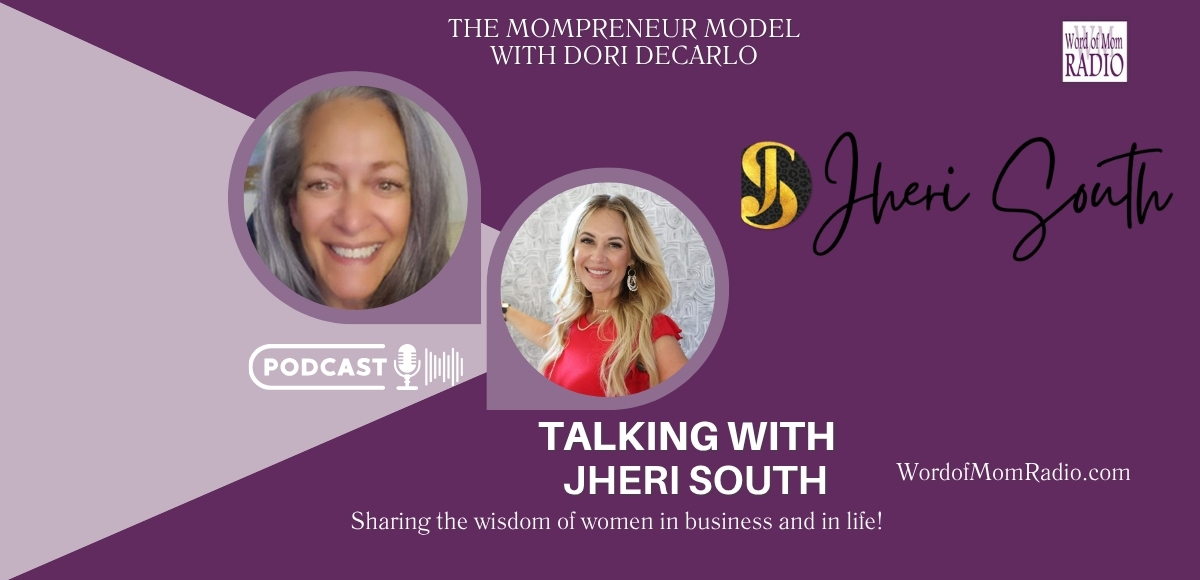
Jheri South is Empowering ADHD Brains with Practical Strategies that Actually Work.
Jheri South, is mom to seven neurodivergent children, rising from the wreckage of a marriage marked by pain and addiction. When her son attempted to take his own life, coaching was the only thing that helped; it saved him and their family.
That experience inspired Jheri to shift her coaching career to a teen and parenting coach, dedicated to helping teens and their parents navigate life’s most difficult moments. Jheri was also diagnosed with ADHD at 40, after a divorce at 31 with six kids and a whirlwind of careers, from airline trainer to dance studio owner to talk show host. The diagnosis finally explained my impulsivity, hyperfocus, and RSD. Her children, all neurodivergent, helped Jheri see the beauty in our brains.
Now, Jheri is a teen and parenting coach, speaker, and ADHD specialist. She helps people navigate ADHD, autism, anxiety, and parenting with mindset, strategy, and community.
Join host Dori DeCarlo on The Mompreneur Model and connect with Jheri at JheriSouth.com and follow on Facebook and Instagram.
Please support UnsilencedVoices.org a global 501(c)3 nonprofit that empowers survivors of domestic violence, sexual assault, and human trafficking.
We thank Smith Sisters and the Sunday Drivers for our theme song, "She is You".
Be sure to connect with us and come tell us your story!
WordofMomRadio.com - sharing the wisdom of women, in business and in life.
Become a supporter of this podcast: https://www.spreaker.com/podcast/word-of-mom-radio--5252572/support.
0:00 If she is sure, she is true, she is straw is straw? She is true? Is true, she is praise, pray, is she is you. Hello, everyone, welcome to today's Word of Mom Radio Here on the Word of Mom Media Network. I'm your host, Dori Di Carlo, and you know we are here show after show, week after week, breaking those myths that moentpreneurs and business women, especially those of us building our businesses from home, that we're just dabbling in between bake sales and getting our nails done. We're not. We are smart, we are savvy, and we are sharing the wisdom of women in business and in life. And I am looking forward to bringing today's guest into our mompreneur model and our coaching corner.
0:48 Jerry South is a mom to seven neurodivergent children, rising from a wreckage of a marriage marked with pain and addiction. When her son attempted to take his own life, coaching was the only thing that helped, and it saved him and their family. That experience inspired Jerry to shift her career and become a teen and parenting coach dedicated to helping teens and their parents navigate life's most difficult moments. Jerry was also diagnosed with ADHD at forty. After a divorce and a whirlwind of careers from airline trainer to dance studio owner to talk show host. Her diagnosis finally explained the impulsivity hyper focus an RST. Her children, all neurodivergent, helped Jerry see the beauty in our brains. Now she's a teen and parent coach. She's a speaker and an ADHD specialist. She helps people navigate ADHD, autism, anxiety and parenting with mindset, strategy and community. And I could keep going on and on, but with all that being said, I'd rather wear from Jerry into the show. So welcome to a word of ONM Radio.
2:07 Oh, thank you so much. I'm really excited to be here today. I'm really thrilled to have you here because as somebody with ADHD, I really there's so much going on in what you are doing that I so resonate with. So I would love for you to take us on your journey, Jerry, and what led you to now finally being that coach that you want. Yes, thank you for the question, and you hit on it a little bit in my bio. So I'll just elaborate a little bit more, because I think a big part of my story is just that I wanted to be a coach. I walked away from being a radio talk show host and doing a lot in real estate to help other women. But I wasn't looking to help teenagers necessarily.
2:52 At the time. My oldest son, he really didn't like me at all, and he was struggling and I didn't feel like I had the tools to help him, and so I was working with women. I was loving it. I felt like my niche was helping women reinvent themselves in business. So even as a single mother with six children, it was something that I had a lot of success with and so that was my passion and it was going great. I was loving it. I didn't need to change what I was doing, except for my son was struggling. And while all of this is going on, I'm having success in my new career, my son is going to therapists and counselors and nothing's helping him. He's not being properly diagnosed with anything, just depression, and things are getting worse and worse, and I really got to the point where I believed I'm probably going to lose my son. He's ended up in a behavioral health facility. And so the women that I was working with, they asked me, will you do a class for teens?
3:50 And I thought, no, No, deans are horrible. I don't want to work with them. That sounds awful. My son doesn't like me. No, you know. Finally they talk me into I did a pilot program. It was about a four week program. It was all in person at the time, and I had about ten to fifteen teens in that class, and it was the first thing that helped my son. And that's when I realized, huh, okay, this is incredible because he'd you know, your kids don't want to take advice from you. And then he's a kid that really doesn't want to take advice from me. And I'm listening to him coach other friends that he has through his bedroom door, the things that he's learned from me, and I'm thinking, oh, my goodness, we've spent two years and thousands of dollars and nothing's helped, and this helps. And so about the same time, my sister was recently diagnosed with ADHD. So my younger sister, she had a binge eating disorder.
4:40 She had no idea she had ADHD. I had no idea any of us had ADHD. Didn't know a lot about ADHD at the time, and she gets diagnosed with ADHD, and so we all start getting diagnosed and that's when everything starts clicking and making sense. And so initially when I dove into ADHD, it was to help my my own family. ADHD has a very high comorbidity rate, and so there's usually going to be more than one diagnosis and overlaps with other things. And so I sat down in doctor William Dodson's home with the camera crew for four hours and asked him every question I could think of. And so I initially just wanted to really help my family. But I am at this time a coach for teens and families, and so it just kind of naturally happened as I'm diagnosed as well with ADHD, that I started specializing in neurodivergence.
5:32 And I really take it seriously. I mean, I'm passionate about constantly going to conferences and interviewing specialists so that I have the best information. But I have had a lot of success doing what I'm doing, because in my opinion, there's not really enough information out there for neurodivergent individuals. So that's what I do, and I love it. And because all seven of my children are neurodivergent, and so is my husband, we are just one big neural divergent a little chaotic times family. Explain to people what neurodivergence is, because it's something that when I say that to people and try to explain, well, here's neurotypical, here's neurodivergence, I would love for you to give people an explanation. Who are hearing this going wait a minute, right, well.
6:20 A really simple way to understand it, because I will say that there is confusion sometimes if you hear neurodivergent, one might make that mean just someone who's on the spectrum. And so it is important that we define it because you know, we want we want to make sure we understand what fits under the umbrella of neurodivergence. So we refer to UH. I don't want to call it average, but most people have a neurotypical brain. And all that means is it's not that it's better or worse than. A neurodivergent brain. It just means that more people have a brain that looks a certain way on brain scans, and that means the way they process information, the way that they learn, the kind of control that they have over impulses, just the way that their brain is operating. Their neurological system is neurotypical because it looks like what most people are experiencing. Now, neurodivergent is anyone who is on the spectrum or has ADHD.
7:18 It all falls under neurodivergent brain. And we can see the difference between a neurodivergent brain and a neurotypical brain as early as infancy on these brain scans. Now, we could kind of get into the weeds on like, oh, different kinds of ADHD and treatment, but overall, if you're a neurodivergent, the way that you process information, the way that you think about things, the way that your brain learns is different. It's not worse. It's not you know, there's not one that's better or worse. I would say that neurodivergent individuals have many gifts, but a lot of times those gifts aren't really being they're not shining right, They're not being seen. When we're in the school system, for example, because because a neurotypical brain can get engaged just because something is important or there's a reward at the end. They can sit still for long periods of time even if they're bored, and they can just hear lectures and learn that way, right. And a neurodivergent brain is going to process information very differently. Something that's important that's utterly useless for a neurodivergent brain, something has to be activated in their neurological system to be able to get engaged, something that's novelty or something that's urgent, right, or that they're passionate about, or even is a challenge or competition. And so really the reason we want to understand is this a neurotypical brain or is this a neurodivergent brain, because it's going to change how we help that person get engaged and get things done.
8:47 And how we communicate with that person. So if somebody doesn't know they're neurodivergent, and they're sitting in a school classroom and they're comparing themselves to other people who are just getting things done and they're hitting dead and they're able to be consistent, they're going to start to think that something's wrong with them, when really they just need tools for their unique wiring system, and they'll find they're just as capable, if not more at times, they just have to learn to do things a little bit differently. How do you help parents navigate this, because it really is just finding that pathway that now it's clicked with them in that neurodivergent way where it's not the neurotypical person that you can just it's not the black and white that we are used to. There are so many shades that go in there. So what do you do with parents as they are trying to navigate this with their teams?
9:44 Well, that's a great question because we always say, oh, awareness changes so many things, but it really is everything. Because if you're looking at your child and you don't really understand ADHD or something that will happen pretty commonly is will know that their child has ADHD, but there's still a lot of confusion over what they can control and what they can't control. A child who is ADHD, we'll say. By the time that they are ten years old, they've heard over twenty thousand corrective messages, and they're usually messages that sound like, oh, why can't you just sit still? Why can't you do this? Your brother can do this?
10:24 What's wrong? How come you can't keep up with your work? Why can't you pay attention? And those are just simple comments that any parent it's going to say that to their child if they don't have awareness to ADHD and their child is having behavioral issues, or they appear to be lazy and they're not getting their work done. So one of those statements on their own isn't necessarily bad parenting or anything like that. It's just that it shows that that parent doesn't really understand how the ADHD brain operates. So when I'm working with a parent, first of all, I always let them know, please don't ever beat yourself up for things that you don't know. There's no place for shame ever. You know, we're always doing the best that we can. Any parent who's trying to get their child help, we want to commend them, But there's things that the child needs to work on, and there's things that the parent needs to understand, and so when they really understand, Okay, just because you throw ice cream at a child after they get their homework done, or you, I don't know, set aside a reward that you came up with or something's really important, your child's not going to be able to do that.
11:27 And this is what I'll see really. Often is that, let's say math for example, because adhders usually aren't very good at math, they'll say, okay, give all kinds of throwout rewards for doing their mouth. It doesn't work, nothing works, and this child is failing their mouth class. And then there's some big exam, let's say it's an end of quarter exam, and they know, the child knows if they fail this exam, they're going to have to take the entire class over Urgency kicks in for that ADHD brain that they've never they can't create that artificially, and they study and they get a BE on their exam. Now every adult in their life says, see, you can do it. You're just not applying yourself. You're just not trying hard enough.
12:07 You can do it. And the child is so confused, just as much as the parent. Why was I able to study and get a B? But I'm failing all of my class work Because they don't know how their brain works either. And this is why a child will experience such a hit to their self esteem or their self confidence because they don't understand themselves, they're not able to be consistent, and the people in their lives are disappointed in them. So when a parent understands, here's how the ADHD brain works, here's how you can help them become motivated to get things done. Here's the things we can inject because into the situation. Because they're not being lazy, they know what they need to do.
12:48 An adhder, their IQ is above average usually, so that's not what it is. It's not laziness. And then another big part of this is RSD or rejection sensitivity to just because we used to think of ADHD as just not being able to focus distractability, but it's just as much emotional dysregulation. So when a child is really acting out, having a tantrum, incredibly sensitive, you can't make a remark without them blowing up. There's actually something to that. It's their wiring. It's not them wanting to behave so just them understanding. We set clear boundaries and consequences. We implement tangible rewards, so they're getting a diggy dopamine hit and a weekly dopamine hit. The more the parent understands that the child can't control most of these things with the understanding that we'll start helping the child learn how to do that. It's a lot easier for a parent to then, because usually it's parents losing their patients because they're having to say the same things over and over again, or they keep getting the same results that they're unhappy with with their child, and so they're just assuming the child doesn't want to or as lazy or as misbehaving.
13:57 On that note, we're going to take a quick break. I want you to really think about what Jerry is saying, because giving the kids the tools that they need, it's also giving yourself, as a parent, the tools that you need to realize that they are not doing this to misbe made or anything. They're just not seeing it the way everybody else does. So we're going to take a quick break, say thank you to our supporters, and we'll be back here in just a moment. On Word of Mom Radio. She is brave, she is bold, she is you, and we want to tell your story. Are you ready to share your journey with us on Word of Mom Radio.
14:39 Go to wordommradio dot com and register as a guest. We want to tell your story because when you win, we all win. In twenty seventeen, Unsilenced Voices was formed to help survivors of domestic abuse and gender based violence worldwide. The organization currently serves Siri Leone, Rwanda, Ghana, and the USA. In twenty twenty two, Unsilenced Voices gifted over thirty three thousand dollars to survivors in the USA and in sierri Leone. There are over twenty six young girls who have been rescued from sex trafficking and domestic abuse and now going through vocational training school in order to better their lives.
15:26 We need your help. Donations are critical in order for us to continue our work. We also need volunteers to help with research and development. Please visit Unsilenced Voices dot org for more information. And we're back here on Word of Mom Radio. We are speaking with Jerry South about our kids ADHD parents dealing with their kids that are neurodivergent and helping them find those tools that can help them with their kids and help them the kids themselves as well. In looking at all of this, how do you help guide parents to support their teens without slipping into that micromanaging or that unintentional shaming of them which they're not trying to do, but it just kind of happens. How do you work with that?
16:19 Jerry Well, As a coach, before I was specializing in ADHD, I was working primarily on mindset And one of the things I talk to parents about is when they have an ADHD child, they're usually trying to help their child regulate themselves because RSD, as I mentioned before, rejection sensitivity dysphoria is going to be present ninety five percent of the time when it comes to eight, I should say with ninety five percent of those who have ADHD, then it's going to show up either in sensitivity or lashing out, being very quick to anger. And so a parent is typically having to deal with that that either their child's shutting down, they're not getting anything done, or they're making a big deal out of all of these things that the parent considers to be relatively small things.
17:09 So when I'm talking to a parent, it's like, well, how are you demonstrating that? Are you impatient? Are you yelling? Are you making critical comments? And I'll be the first to say, as a parent, I was definitely doing that. I mean most of us are until we learn to not do that. Most parents are yellers until they learn to not do that just because we haven't as parents. When I was young, I wasn't taught how to regulate my emotions. I didn't have a mindset coach who taught me how to process pains. So I either avoided it and distracted myself, or I know, lashed out, or I shut down. And parents, we want them to know how to show up for their child. These kids, these ADHD children, they and this is true for adults too, but especially kids.
17:54 They are so sensitive. Adhders are such deep feelers. I don't know anyone else rather than adhders who can look back at an event that happened five years ago and still bring all of the pain that they felt that day into today just by thinking about it. So when we're up, we're up, but when we're down, we're down, and we're up and down even just that that influx of emotions can cause such irritability on the regular But parents trying to manage that are usually impatient and quick to discipline and really not understand their child. So we are putting processes in place. One for the parent to learn how to regulate themselves. That's huge, because then not only do they have the language for their children, they're also demonstrating a great example. But they are having that pause where instead of the lashing out of their child or saying something that causes the child to feel small, especially you know, RSD is triggered by the idea that we fail to meet someone else's expectations, they're pausing. They're showing patients understanding. They're really trying to understand what the child's feeling and what they're going through.
19:03 We know that. RSD rejection sensitivity dysphoria. It's mostly perceived rejection. So it could be a child being very sensitive and they're internalizing things in a way that didn't happen, but it doesn't matter really because to them it's happening. And so as parents, we want to know those signs. We want to understand how to de escalate. We want to know you can't as a parent, get a child out of. An RSD episode. They have to be able to be excused, to walk away, to work through their thoughts. And as parents, a lot of times we're saying, no, you stay here, we're talking about this, Why aren't you apologizing because we don't understand RSD, And then The other thing is that adhders are known for really not liking to be told what to do and really you know, wanting autonomy and so coming up with systems at home where we do different processes. But you know, kids are getting credit for the things that they're doing because the ADHD brain, when it comes to executive functioning, it's about three years behind, you know. So if you have a fifteen year old, they're not actually operating like a fifteen year old, you know, it's more like twelve. And so when parents say things like I shouldn't be having to remind them at this age or you know, whatever it is, it's like, well, probably actually yes, because they're operating like a twelve year old, And so just knowing that they'll catch up, but they're going to thrive and do a lot better in a calm environment where there's no yelling. And then when it comes to getting their things done, whether it's homework or it's chores,
20:33 just understanding that the ADHD brain is very easily overwhelmed. So we want to break things down into bite sized pieces. We want to take small breaks, and we also want at the end of the day, we want to have something that they can check off, they earn their points. They're getting a dopamine hit at the end of the day and the end of the week to keep them motivated. Parents will often do this, Hey, if you get all a's by the end of the quarter, we'll go to this camping trip or whatever. It is. No way an ADHD brain is going to last until the end of the quarter. Two week stops. So these are just small adjustments that make change and give huge results if parents understand the way the brain is working. But that very authoritarian parent style. Because I said so, most adhders are either going to shrivel down and give up on most things and learn to people please and mask a lot with a very fragile self esteem, or they're going to rebel.
21:29 They need to be on a routine, but it can't be. Too rigid, and you share a success story or a breakthrough that you've witnessed that really stays with you as something that wow, that was so awesome. Well, because I do. I've done this work for years now. I have quite a bit, but the one that I highlight the most often, and I've had other children that I've worked with, other teenagers. I should say in this similar situation. But the very very first teenager that I had this breakthrough with has never left me because I had a teenager that was really struggling. She had been she was a client, not my own child, but she had been in therapy for two plus years, and fortunately she had a really good relationship with her mom, so she relayed things to her mom many times.
22:23 That's not the case. I should just put that out there that parents don't know what their children are hearing in therapy. This particular therapist told my client, who I wasn't seeing yet at the time, that it was okay if she was cutting herself and engaging in self harm as long as she didn't cut too deep. And yeah, this really happened, and this isn't abnormal by the way. I mean, you hear these kinds of things, and so that's why I highlight that fortunately she had a good relationship with her mother. Her background was that she had lost a brother to suicide, then she had been sexually assaulted, and then she lost another brother to an accident, all in a year and a half and year and a half two years. She had been struggling for quite some time, and her mom was taking her to therapy because she was hurting herself, and so her mom brought her to me.
23:12 And this this young woman had been cutting herself for over two years, and within two months of coaching, she stopped cutting, and to my knowledge, she never cut again. She would text me updates and it's been one hundred days and it's been a year, and so it's not perfect. I mean, she still struggled with other things. We still did coaching for a while when I wasn't working with her anymore. I saw that she had some up vases and down phases, but she didn't go back to depression and self harm. And now she's thriving and doing great. She's an adult. But that was huge because when it comes to ADHD, specifically being intense feelers. You know, I was just talking to someone earlier who's struggling with an alcohol addiction, and I said, you know, I don't love that we label things like that with I'm an alcoholic, because when you have ADHD, that's not actually completely accurate. Is I am addicted to chasing dopamine and my brain doesn't care where I get that dopamine doesn't care if it's junk food or drugs or pornography or alcohol. It just really wants the dopamine, and adhders will easily become addicted to anything unless they have the tools. This is why I'm not a medication pusher. I'm not against it, but there's a lot of people who I understand they're not on it.
24:24 I'm in the middle, people who really have problems with their impulse control. They'll say you are three to four times more likely to engage in some kind of substance abuse because it's hard to control the impulsive brain. I don't believe in using ADHDS a crutch. I like using it for an explanation and then let's stop telling those stories and move on. So a big important part of my work is still just mind shift, and I combine that with everything I know about ADHD. But those words matter. You know. If we say, oh, I'm addicted to this or I'm addicted to that, most adhders will have a story like that. I have a past too that we really we just don't understand our brain and it's hard to control. When we're younger, our prefrontal cortex hasn't finished developing. We're three years behind and executive functioning, and we are depleted in our dopamine and will do.
25:09 Anything to have it. And so that's kind of a terrible combination for a high schooler who's trying to fit in at school and doesn't understand themselves and also not doing well in the school system. So as parents, we want to understand that teenagers. They'll tell me. The thing I hear the most often in here when it comes to their complaints about their parents is that their parents don't know what it's like to be a teenager today. And parents will say, oh, please, you know I was a teenager. But they're right about that. We don't know what it's like to be a teenager today. We didn't have social media and you know, cyberbullying and the pressure of all the popular girls dressing exactly like the influencers and we're not or whatever it is. You just add that to the intensity of emotions the adhders feel.
25:54 Adhdeers really need support from adults who get them. Great way to wrap up this conversation as we're closing out, Jerry, what would you like to leave our audience with and how may they reach out to you? Well, there's so many things, right, but as an ADHD mom who never knew that I had ADHD. I will say that getting a diagnosis was super helpful. It put it just kind of helped my life make a lot more sense. There was a lot of things I struggled with over the years, growing up and going through a divorce, and then there were a lot of things that I had success in. And so I would say, at the end of the day, as a woman, an entrepreneur who was also a mother, there were so many obstacles and things that got in the way, and whenever something would happen, I realized that the first decision I would ever make was what I was going to make it mean. And I also know that the decisions that we make, the mindset that we have, they do determine destiny. We are quite literally hunting ourselves the results that we get by the way that we choose to think about things. I look back over my journey and there were so many times that things felt impossible and I didn't see how it was going to get out, and I guess what I would leave with the audience. There's so many things right, But this has been true for me and for my children, is that if we can stay focused on what we want to believe about ourselves and really do the work, whether it means getting a coach or having somebody a mentor that can help us stay on track and really see ourselves for our potential. I really think that we
27:28 were meant to be able to accomplish our dreams and have the life that we want. But we have to have our mindset in the right place to get there, and then anything's possible. And as far as where people can reach me, I think you asked, they can go to my website. I have a unique spelling, but it's Jerysouth dot com so j H E R I s O U t H dot com. And I'm also on social media as jerryself and on YouTube. But on my website, not only can you schedule a free consult with me for my coaching program, but I have things like a free ADHD quiz on there. I have a free webinar and RSD so there's. A lot of things there for adults and also parents and their children.
28:11 I really encourage you. All of Jerry's lengths are going to be live on Word of Mom Radio reach Out because as parents, the more tools we have in our toolbox dealing with our children, our grandchildren and the people around us. Yay. That's all I can say is just yay, get the tools. Get the tools. And for the parents that are out there and just feel like there's no light at the end of the tunnel, trust me, the light is there. The end of the tunnel is there. And if you learn those tricks, learn those tools, learn how to understand that your child's not doing something to get back at you, to misbehavior anything else. Sometimes it's not possible for them to control the impulses that they have, and that's where this understanding comes in. Jerry, thank you.
29:07 I thank you Jerry for all of the kids that are out there, and the moms and dads that are out there that you are working with, and those that you haven't met yet but that you're going to be working with. Thank you for the work that you're doing. I really appreciate it. Oh, thank you, and thank you so much for having me here and having this important conversation. I appreciate it. It has been my pleasure. And for all of you tuning in, thank you for being here. We're going to close out with our fabulous theme song from the Smith's Sisters and the Sunday Drivers, So till next time. This is Dori di Carlo saying, go out and create a marvelous youth. Bye for now. She is sure, she is sure, she is strong, she is strong, she is true, is true, she is braise, bray is she is you?
29:54 Please you, she is you. She is sure, she is sure, she is strong, she is strong, she is true, is true, she is brave, she is bold, she is she is you, is she is she is sure of herself. Yes, she takes care of his powerful and strong. Yes, she knows who she is has integrity, woman, strong and true. You know her by name. See this woman is you. She is sure, she is strong, is strong, she is true, is true, she is brave, she is bold, she is you, she is you, she is she is sure, she is strong, is strong, she is true, is true, she is brave, she is bold, she is she is you, she is she is adds value and hope has proved to be brave.
30:51 See it's never too late, never time to behave Reaching for dreams doesn't matter. The age believes in herself. Leash from her age. She is sure, she is sure, she is strong, is strong, she is true, true, she is brave, Bray, she is bold she is you. She is she. Is sure, she is she is strong. She is strong, she is true, is true. She is brave, is brave, she is bold. She is you.

Teen and Parenting Coach; ADHD specialist; Mom to 7 neurodivergent children
I’m Jheri South, a mom to seven neurodivergent children, rising from the wreckage of a marriage marked by pain and addiction. When my son attempted to take his own life, coaching was the only thing that helped; it saved him and our family. That experience inspired me to shift my coaching career to a teen and parenting coach, dedicated to helping teens and their parents navigate life’s most difficult moments.
I was also diagnosed with ADHD at 40, after a divorce at 31 with six kids and a whirlwind of careers, from airline trainer to dance studio owner to talk show host. The diagnosis finally explained my impulsivity, hyperfocus, and RSD. My children, all neurodivergent, helped me see the beauty in our brains.
Now, I’m a teen and parenting coach, speaker, and ADHD specialist. I help people navigate ADHD, autism, anxiety, and parenting with mindset, strategy, and community. I’ve spoken on stages, in schools, studios, and podcasts, and I’d love to join you on yours!