
 Spotify

 iHeartRadio

 Amazon Music

 Apple Podcasts

 Pandora

 Youtube Music

 PlayerFM

 Overcast

 PocketCasts

 Goodpods

 Podyssey

 Audible

 Podchaser

 RSS Feed
Jessie Kensey on The Mompreneur Model with Dori DeCarlo
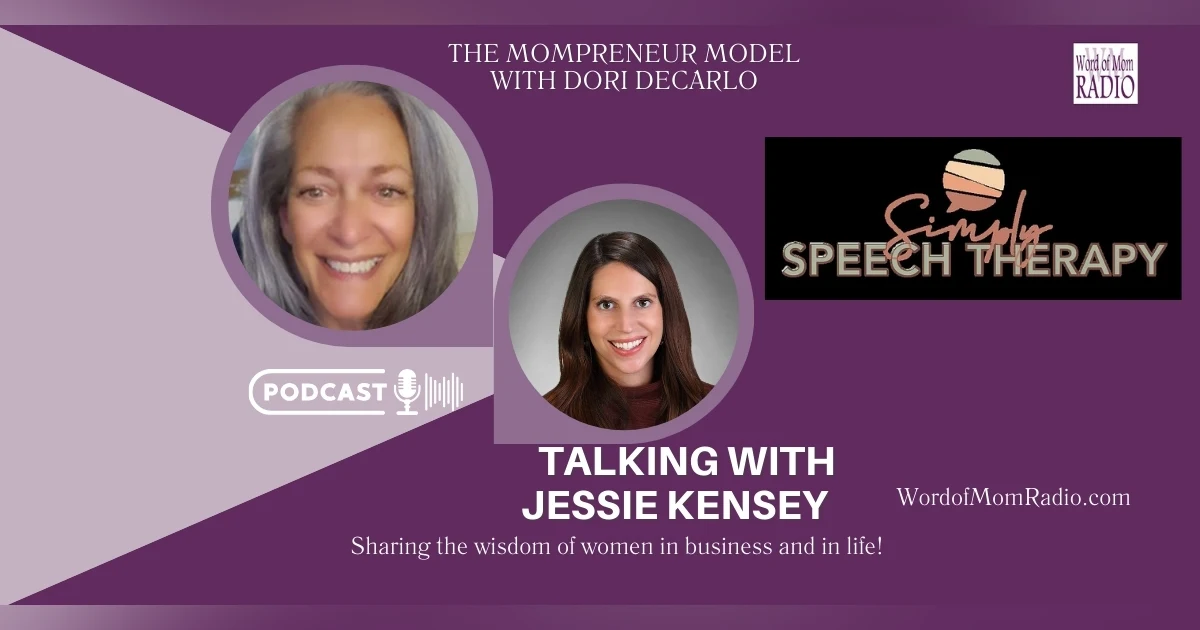
Jessie Kensey and Simply Speech Therapy Provide In-Home & Online Speech Therapy for Kids of All Ages.
Jessie Kensey is a pediatric speech therapist and founder of Simply Speech Therapy in Orange County, CA. As a mom to a baby and a toddler, Jessie blends lived experience with professional expertise to support early communication.
She provides both speech therapy and parent coaching—helping families feel confident using baby signs, boosting toddler language, and reducing frustration before speech delays or tantrums arise.
Her approach is all about making communication support simple, practical, and part of everyday routines.
Join host Dori DeCarlo on The Mompreneur Model and connect with Jessie at SimplySpeechTherapy.org and on Instagram.
Please support UnsilencedVoices.org a global 501(c)3 nonprofit that empowers survivors of domestic violence, sexual assault, and human trafficking.
We thank Smith Sisters and the Sunday Drivers for our theme song, "She is You".
Be sure to connect with us and come tell us your story!
WordofMomRadio.com - sharing the wisdom of women, in business and in life.
Become a supporter of this podcast: https://www.spreaker.com/podcast/word-of-mom-radio--5252572/support.
0:00 She is sure, she is true, she is straw is straw, She is true, is true, she is praise, pray, she is she is you. Hello, everyone, welcome to today's Word of Mom Radio. Here on the Word of Mom Media Network. I'm your host, Dori Di Carlo, and you know we are here week after week, show after show, breaking those myths that morepreneurs and businesswomen, especially those of us building our businesses from home, that we're just dabbling in between bake sales and getting our nails done. We're not. We are smart, we are savvy, and we are sharing the wisdom of women in business and in life. And I'm looking forward to bringing today's guest into our show. Jesse Kenzie is a pediatric speech therapist and founder of Simply Speech Therapy in Orange County, California.
0:53 As a mom to a baby and a toddler, Jesse blend's lived experience with professional expertise to support early communication. She provides both speech therapy and parent coaching, helping families feel confident using baby signs, boosting toddler language, and reducing frustration before speech delays or tantrums arrives. Her approach is all about making communication support simple, practical and part of everyday routines. And I can share more about what Jesse does, but I'd much rather bring her into the show. So Jesse, welcome the Word of Mom Radio.
1:34 Hi, thank you so much for having me. I can't wait. Oh, it's my pleasure, and I would love for you to take us on your journey that led you to start simply speech therapy and how being a mom has really shaped that work. Yeah, absolutely my journey. Goodness. I actually was a high school English teacher. I decided to go back to school and get my master's and I really stuck in the schools for a long time. I was at a middle school as a speech language pathologist, and I enjoyed that experience a lot. But when my first son was born, I realized that that just was not the best fit for me anymore. I had always wanted to start my own business, and that was kind of the push that I needed. So I literally on my maternity leave, with my little baby boy at home, I started simply speech therapy.
2:24 So he would nap and I would work, and it was definitely chaotic, but it was also really beautiful and he was so motivating right because I knew I was building something because I wanted the flexibility to be able to work part time, to be able to, you know, work in the moments as a mom that we have as little as they might be. And so I really just started my business super small and now we've grown, which is amazing. So now simply speech therapy in Orange County. We are a four person team, which is beautiful. And then I also coach parents of babies and toddler's late talkers, those little ones that their parents are starting to worry. I really helped give them support before they even potentially need speech services. So it's it's been a journey. It's been very fast and chaotic, and I have, like I said, I have a baby and I have an almost three year old, so my business is still fairly new. It's about three years old now because I started with my little one at home. But it's been a really great journey so far.
3:25 I love sign language. I used to be an interpreter and we were talking before the show started, my middle son who's speech delayed, and I taught him to sign because I used to sail on you and they designed her NA have to save you and tell mommy what you want to understand you. And it's amazing because now as an adult and a parent on his own his daughter they signed and he asked me, he said, wasn't this my first language? And I said it was. I said, and you'll see how fast it'll come back to you, just because baby signs are great. So how did you get started with baby signing? Did you start it with your children and then start integrating it into your practice. It was kind of the other way around. I had done some early intervention services. I had worked with littles before I became a mom, and I used baby signs then, and I saw how impactful it can be for these little ones that just aren't quite ready to start talking yet and they haven't quite figured it out. I saw like, hey, wow, I can teach baby sign and they can pick up on it and they can start telling us what they need and what they want. And so I saw that before I came a mom. So for me, when my little ones were born, it really wasn't even a question.
4:38 I knew I was going to be using, you know, those simple baby signs, and I did. I started it with both of them. They both signed before they started using verbal words. Even my toddlers. Sometimes if you like really really want something, they'll like look me right in the eyes and instead of like just saying the word now, he'll sign and he'll say the word like mom, I need you to see this, and I love it. So Yes, baby signs are great. Although I will tell you I am not and this is for anyone listening. I am not fluent and sign. I wish that I was. I have taken some classes and I've learned from people that are fluent in ASL, and I someday that is on my list. But you don't have to be fluent in sign language to teach your little one baby sign. I really think knowing anywhere from like three to ten signs that you use consistently is like, really where that magic happens for your little ones.
5:30 It's amazing because more please and thank you, but stop, sit, I love you. My little ones, my kids and my grandchildren were signing I love you since they were babies, and it's so fun because they want to tell you these things, and those babies are battling. People don't realize they are speaking. They know exactly what they're saying when they're looking at you, giving you baby babble and things. So when they have some signs to throw into it, it really cognitively just really helps them click it all together. Yeah. You know, during COVID we did a lot with speech therapy and things like that because schools were closed and so often parents don't see some of the earlier signs that their toddler's ready to communicate but having a hard time is delayed somewhere. What are some of the things that they can look at and look for to be able to get that communication started.
6:33 Yeah, so kind of two parts to that. One is there's so many milestones and there's so many things for little ones that it can get really really overwhelming. But I do think as you're watching your little one, as they're getting close to a year, as they're hitting eighteen months, as they're hitting two years old, you know those are the time, so just be making sure they're hitting those kind of basic milestones. One thing though, to keep in mind when you see milestones, you know, there's social media and there's just so much information out there that sometimes sometimes what you're seeing out and about in our world is there's there's really is a difference between a milestone and an average and so you need to just make sure that your little one is hitting those milestones. So that might be you might see something scary on Instagram by like okay, you're your eighteen month old can have fifty words, like okay, maybe, and that's great. But also as long as they have about ten then they're doing just fine. And so I think the first thing is that there's there is this kind of like range for every age, So understanding like that there is a range, and as long as your little one is meeting those milestones, then they're doing great. Talking to their pediatrician just at their you know, well baby appointments can be really helpful.
7:46 I have a checklist that has just kind of those basic milestones. So if you consistently notice that your little one is missing those milestones, you know, if they hit a year and they don't have one word yet, one word or sign or even animal, not anything, lots of things count, but if they don't have that one word, if they get to eighteen months and they don't have around ten words, and by two years old there is a jump. We want to be at about fifty words, and if they're not hitting that, those are those you know, just like hey, you know what, maybe look into it a little bit. Obviously there's a lot of nuances in there, but I think kind of understanding those general milestones can be helpful. And then the other thing is, as a parent, you can start really really small. It doesn't have to be okay, zero, two, one hundred, It can be okay, you know what, I'm starting to be a little bit worried.
8:32 I feel like I'm seeing, you know, other kids at the park they're talking, but my little one isn't. Or you know, I'm taking my little one to family Thanksgiving and everyone's saying, oh, why isn't he talking yet? If you're starting to kind of hear those things, you're starting to get nervous. Just are small. Just start incorporating some simple strategies, you know, And obviously talking to your pediatrician is always a really good start. Too, it is. And I love what you said about social media because you know what, don't judge your parenting and your life on influencers who are out there all dressed and their baby looks wonderful and everything else. And meanwhile, you haven't washed your hair in three days, and you probably have baby spit up in it and everything else, and now you think you're failing because everybody just makes it look so easy out there, and it's such a disservice.
9:24 On the one hand, it's a wonderful thing. It's a wonderful thing to be able to look up to find support groups and things like that. But there are people that are out there that make it look like this is how their child always looks, and their kitchen's always perfect, and they're always dressed in the June clear and they've got their pearls and blah blah blah blah. And then, like I said, you're sitting there in your sweppants wondering what you're doing wrong. Guess what, mommy, You're doing nothing wrong. You are doing a great job. You got up, the kids got bed and everything else, and they all got put to bed at night. You did it. Good for you? Repeat? And how do you compat that for parents, because again, in today's world, parents think that they're failing because they don't look like what we see.
10:12 Yeah, I think so many of the conversations I have with parents, you know, in my therapy practice and even just like in parent consultations or is reassuring them, you know, I think that there's just such a piece of we kind of are expected to do it all, especially as moms, especially as entrepreneurs, especially as like there's just so many hats that we wear every single day. But usually I'll start talking to a parent and I'll reassure them, right, like, this is the stage where little ones are learning, they're growing, and there's just so much going on in a beautiful way, and you get to just kind of grab on to that and work with it. And so much language happens during things you were already doing. So if you are changing your baby's diaper, you have a language opportunity, right, If you are giving your baby up in the morning, that's a language opportunity, eating breakfast, going to bed, taking a bath. Like most of what I would tell you to start adding is during the things that you are already doing. You do not have to sit down and play with your child for one solid hour of nonsub language play, Like, okay, cool, you can do that if you want, but you don't have to. Everything that I would teach in every strategy that I have would just go in all those little moments that you are already doing throughout your day already. And yes, I said before we jumped on this club. It's like, Okay, I have two babies. They might wake up and that's just the reality of parents. It's definitely not instagram perfect all the time.
11:39 It isn't. And as I said to Jesse, it's word of mom radio. So we love kid cameos. We do. My grandkids have popped into shows and stuff like that. Why not. And if we can't support each other as momrepreneurs, entrepreneurs, business owners, raising a family, building your business, that's what it's all about. And it is that juggling act because balance, I mean, come on, seriously, it's light. It is your life, raising a family, building a business, and everything else. And we keep all the balls in the air because we're good and sometimes the ball's my ball, but we still find a way to pick them up. So what are some of the earliest signs parents can look for that their baby or their toddler is actually ready to start communicating?
12:30 Yeah, so I think the biggest things that really are like those first indicators, is that they are starting to imitate what you're doing. And that doesn't have to look you say ball, they say ball, right, that's great, But really those signs come so much earlier than that. So my baby, he's not one yet, and him and my toddler like to talk together. I would put talk in air quotes, but my toddler will like scream because we thinks it's funny. He'll scream and then my baby will scream, and then he'll scream and my baby will scream, and they will go back and forth and back and forth. And that shows me, oh, he's catching on. He's getting ready to start talking. Because one the baby is imitating what my toddler is doing, right, and if they're imitating what you're you know another sibling is doing, or what you're doing, even if it's like you scream and they scream, or like you say bah bah, they say babe bye, even if it's not real words, that's showing me that they're getting ready and that turntaking is so important too.
13:30 So again, like if you notice, hey, my baby does something and I copy because it's cute, and then they copy it back, and then I copy it back, like, those are those signs that tell me, you know what they're getting. They might not be talking yet, but they're getting ready to talk. And I would say the same thing works really well. I know we talked about baby sign but the same thing is true for gestures. So if you notice your baby is starting to wave, starting to point, maybe it's with their whole hand or point with a finger. If they are starting to you know, they reach their every time they want you to pick them up. Like those things are showing me that they're just getting ready and they're they're gonna you know, they're probably gonna start talking too. On that note, big of what Jesse said about the signs that our kids show us. We're going to take a quick break, say thank you to our supporters, and we'll be back here in just a moment. On Word of Mom Radio. She is brave, she is bold, She is you, and we want to tell your story. Are you ready to share your journey with us on Word of Mom Radio? Go to wordommradio dot com and register as a guest. We want to tell your story because when you win, we all win.
14:42 In twenty seventeen, Unsilenced Voices was formed to help survivors of domestic abuse and gender based violence worldwide. The organization currently serves Sierra Leone, Rwanda, Ghana, and the USA. In twenty two, twenty two, Unsilenced Voices gifted over thirty three thousand dollars to survivors in the USA and in sire Leone, there are over twenty six young girls who have been rescued from sex trafficking and domestic abuse and now going through vocational training school in order to better their lives. We need your help. Donations are critical in order for us to continue our work. We also need volunteers to help with research and development. Please visit Unsilenced Voices dot org for more information.
15:36 And we're back here on Word of Mom Radio. We're talking with Jesse Kenzie, who is the founder of Simply Speech Therapy, and we were talking about the signs that your child is getting ready to speak. So how we were talking about it a little bit earlier using baby sign for parents that have never heard of that before, how do they find out the simple signs to teach your child you know more and just a couple of little things to move it forward. Yeah. Absolutely, Google is a great place to start. You can definitely go online and just search for you know, baby signs or simple signs. I will tell you if I was to narrow it down to just a few that like go on Google and see what they look like more, stop, all done. Those ones are really really great and they can be so helpful. Eat is another helpful one milk. But like I said, you don't have to have a ton, Maybe just start with those. Start with maybe five signs, six signs. Look them up, see how to do them. I will say, though, when you do start using baby signs, they're probably not going to do them perfect right away. I will tell you, for a long time, my little one's all done, milk and one more sign a more like they all looked almost the same for like a month, and I was like, okay, cool, you're really trying, but I still don't quite know what you're saying. And that's okay, It's all part of the process.
17:01 But just starting with a few signs, you know, things that your little one is going to be using a lot throughout the day. And then just look them up online and you can see there's tons of videos. You can see someone else doing them, so you know what they look like and you can just start using you know, just incorporate one or two throughout your day and then add another one you feel ready. It's actually kind of fun and amazingly when you are out somewhere and your child's a little farther away from you, and you have those couple of signs tell them to stop or sit down or they're you know, all done. It's amazing how it translates. So I'm gonna flip the switch. What are some of the common mistakes and myths that parents have around speech development?
17:43 Yeah, I feel like I've really been a on a I've been talking a lot about myths lately, and I think they're just so interesting. The first one, because we did talk a lot about baby signs earlier, is that baby scigence will hinder language or hinder verbal you know, talking verbal language, and that is not true. That's not true at all, language or signs. I see it as a bridge, right. You're teaching them to use signs before they're ready to verbally communicate, because our little ones usually get those motor skills first, and then you're basically just showing them, hey, look you can do these signs. These signs mean something, and then they're gonna it's gonna click for them. Oh hey, if I can sign more, you know what, I think I can actually say more, and then my mom gives me more, and that's super rewarding.
18:34 That's easier. I'm just I'm gonna do that. So signs do not make it so your little one will you won't talk, right, That is not true. So don't be afraid use those signs. You will be glad you did. And then the other if I was, if I was to narrow it down, the other one I think is and I know pediatricians say this and they're so well meaning, and friends say it and they'll just say we'll wait and see, and I guess that, and I think, you know, to some extent it is true. Every child is learning at their own pace. I know, you know with with my toddler, his motor skills are like off the charts, but he's not the most chatty kiddo in the world. But he is meeting his milestones. And I'm not concerned.
19:19 But if you really truly have a concern and you know in your gut, like you know what I think something, you know, I want to get him more support. I feel like there's just something going on, then wait and see always kind of just gives me like augh because you might be missing something. And so if someone tells me wait and see, okay, great. And also, don't be afraid to keep asking. Don't be afraid to you know, reach out to a speech pathologist, maybe get some other support outside of you know, just that wait and see comment. I agree with you one thousand percent. And we talked about it before the show. When my son, who was speech late, I taught him to sign. That's what the speech therapist said to me. Then, of course he didn't learn how to speak. You taught him to sign. And I literally to her, did you get your degree in a crackerjack box? I did, because I just couldn't believe that a speech pathologist would actually perpetuate that kind of a myth. It was scared, it really was. So kudos to you that not only don't you perpetuate it, you encourage parents to mix it all together because again, cognitively, like you said, they have motor skills earlier than verbal skills.
20:30 So when you can get all of that to mesh, it's like reading to a child. The more you read to them and reading the same books over and over and over again, it develops language development. It also teaches them to recognize letters and words and things like that. So it may be boring to you, but kids don't realize It's why you could put on a movie, a Disney movie, and as soon as it finishes, they want to watch it again because they don't have that time span of we just watched this, it's done, they want to see it again. So it's it's kind of interesting the things that you have to fight sometimes and the relearning reteaching of parents and grandparents and the well meaning aunts and uncles out there who just want to help you along. Oh now I'm going to go into as a mombadur, as somebody who you know owning your own business.
21:31 You've got a toddler and a baby. How are you keeping those balls in the air? And what do you want to say to that mom out there who is looking to make that shift in realizing that working a job isn't what is going to be conducive to raising a family and being the present parent that they want to be. Yeah, I don't know. It's so there's so much involved, but I would just say one, do it. I have never regretted starting my own company minute. It might be a little bit stressful sometimes and it's definitely a juggling act, but uh, it has given me so much flexibility to work in the times that I can work and then also be super present with my boys, which was my goal with that though, I will say I have to set really really firm, really strong boundaries on myself, which is not always easy. But for me, that looks like, you know, if I'm needing to put work away so I can be present, it means like my phone needs to be in the garage, Like I can't even have anything that could allow me to check my emails, you know, follow up with clients, even you know I have a social media, like check my social media. Like I have to be really really aware of how I spend my time because I don't have that much of it, right, I have to be really intentional. So I think setting those clear boundaries, being really intentional about Okay, this is my worktime and this is what I want to get done, or like this is my time with my children, I'm going to be super present there. That has been incredibly
23:01 helpful to me. And I'll also say I have a great support system. I do not do this by myself, and there's no way that I could. I have a team with my company that i've you know, slowly hired over time that they're amazing. My mom helps me watch my boys. My husband is just my biggest cheerleader in the world. And so I think just like and your support team doesn't have to look the same as everyone else's support team. But if you feel like you're going to be a twenty four to seven mom and also build a you know, crazy successful business, like any kind of support that can help you is going to be beneficial, because I think sometimes we do fall into like, Okay, let me be the default mom and the default parent and then also run this fully super successful business and sometimes then you just wind up super brint out and exhausted.
23:48 And so you know, being able to pull from that support that you do have and create really clear boundaries, I think for me that's made this as successful as it has. As a speech there and a parenting coach, how do you meld them and why is that parent you so important? Yeah? So I do coach parents, but I only coach them around speech and language and helping them get their little ones talking. That's really where I focus. But I will say that in compass is basically all aspects of parenting, and I'm basically I'm an open book. So if you want to come in and you tell me that you're having a super top day because you're a little one. How to melt on. I'll be like, Yep, mine had to melt down in the grocery store this morning. It was great. So I think that the fact that I'm living this world with so many of my therapy clients' parents, right, I see a lot of toddlers in my therapy practice and also my coaching families. That's really helpful to me because we just feel like we're all just in this together, and we can collaborate and we can commiserate occasionally, and also I can give strategies that are just really realistic because I'm living this too. If they are, you know, a working mom, if they are a stay at home mom with multip kiddos, if they are feeling like, oh my goodness, how do I fit one more thing into my day? I'm over here like, yep, I get it. Well, let's figure this out together, because the last thing that I want to do as a therapist or as a coach is put more things on your plate that then aren't going to happen because you're already so overwhelmed, right, And so it's really like, hey, let's get down to
25:20 what can we do right now it's going to be super effective, and not just throw thirty different strategies at you and be like, hey, did you practice them all the next week? Because I just feel like that's not realistic. That's a great way to wrap this up, because realistic goals are really important. As we are closing out, Jesse, what do you want to leave our listeners with and how may they reach out to you? Yeah? Absolutely so. The first thing that I would say is if you're listening to this podcast, if you are worried about your little ones talking, you're already are a great parent, because those great parents are the ones that tend to worry about those things. You can find me and a couple of different ways. You can find me at me at Simply Speech Therapy dot org. That's my website.
26:05 You can also find me on my Instagram. I'm pretty active there and it's Jessekinzie dot SLP. I will have all of Jesse's links live onward of momradio dot com and she's one thousand percent right. If you're concerned about your kid's speech, you are already a great parent, just like when you are concerned about anything that has to do with your development. You are doing a great job. So Jesse, I want to thank you so much for taking the time out, especially during nap time, because I know how much work you should be getting done. So I'm so glad that you have the time to share your journey with us because you're doing great work.
26:46 Thank you, thank you, thank you so much for having me. It has been my pleasure. And to all of you tuning in, thanks so much for being here. We're going to close out with our fabulous theme song from Smith's Sisters and the Sunday Drivers. So till next time. This is Dory di Carlo saying, go out and create a marvelous you. Bye for now. She is sure, she is strong, She is strong, she is true, is true, she is bra Bra, she is she is you.

Pediatric Speech Therapist
Jessie Kensey is a pediatric speech therapist and founder of Simply Speech Therapy in Orange County, CA. As a mom to a baby and a toddler, Jessie blends lived experience with professional expertise to support early communication. She provides both speech therapy and parent coaching—helping families feel confident using baby signs, boosting toddler language, and reducing frustration before speech delays or tantrums arise. Her approach is all about making communication support simple, practical, and part of everyday routines.