

 Spotify

 iHeartRadio

 Amazon Music

 Apple Podcasts

 Pandora

 Youtube Music

 PlayerFM

 Overcast

 PocketCasts

 Goodpods

 Podyssey

 Audible

 Podchaser

 RSS Feed
Emotional Intelligence Made Easy on Ask Mom with Sue Donnellan
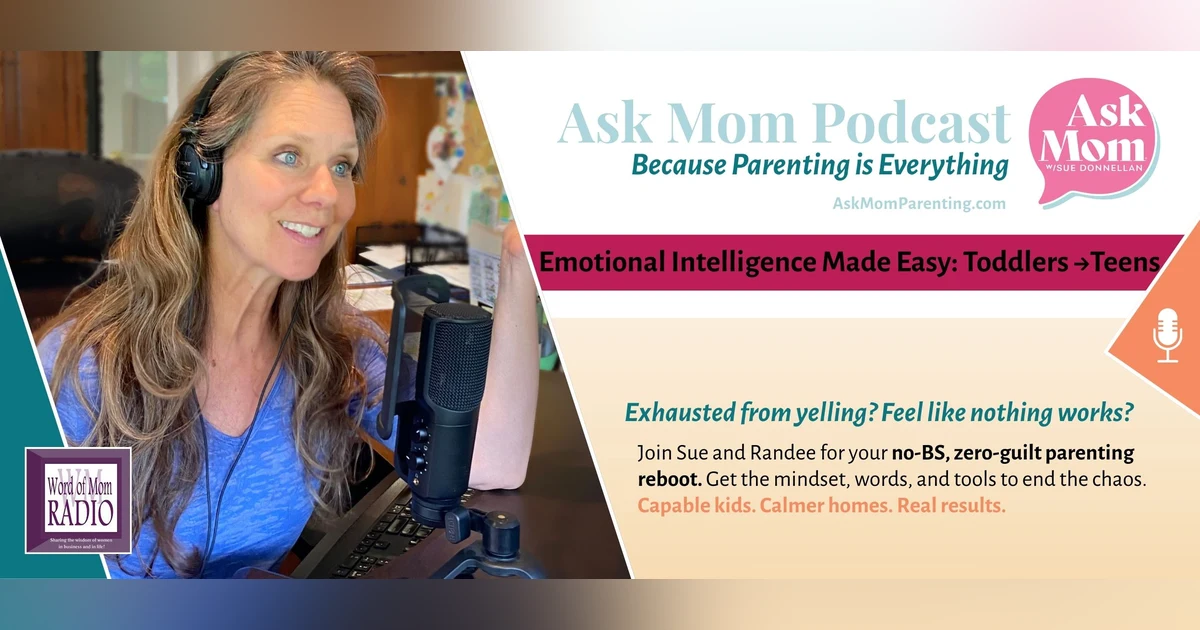
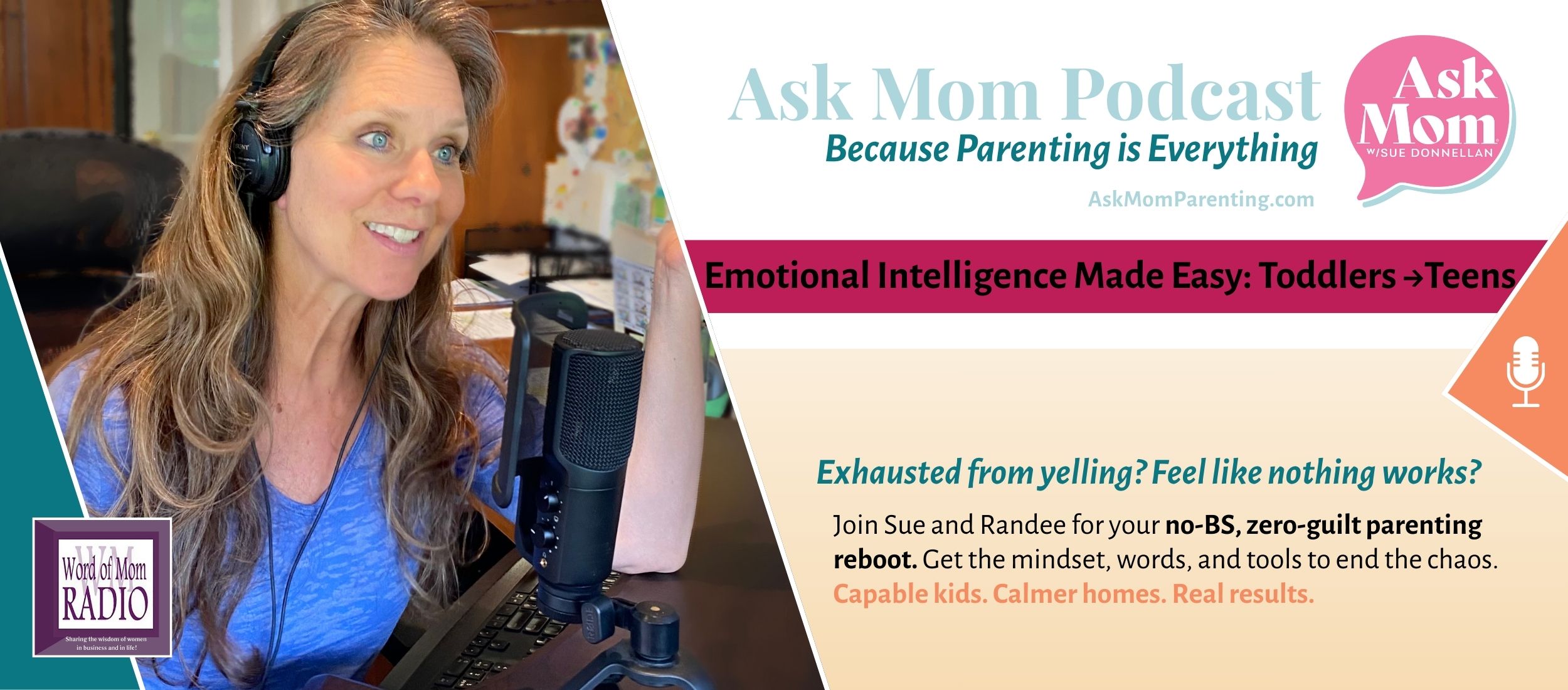
Emotional Intelligence Made Easy (Toddlers → Teens) on Ask Mom with Sue Donnellan
Emotional Intelligence Made Easy (Toddlers → Teens)
If “Use your words” and endless lectures aren’t changing behavior, this episode gives you the missing lever: emotional intelligence + intuition…so kids read the room, trust their instincts, and make better choices (without you yelling). Why listen
- You’re tired of meltdowns, backtalk, and power struggles.
- You want kids who listen, self-regulate, and make wise decisions…at school, online, and with friends.
- You need practical scripts and a simple process you can run tonight.
- You want your child comfortable in their authentic self, making choices in alignment with who they are, not just what the crowd expects.
What you’ll learn
- “Read the Room” for families: the SEE → FEEL → USE mini-framework kids remember.
- How to teach kids to trust their instincts (and how you model it).
- The shift from “fit in” to “feel in”, why it upgrades confidence, mental health, and decision-making.
- Authentic-alignment checks kids can use: “Does this feel like me? Does it match my values and my gut?”
- The 360 & Release Method for tough decisions
- Real-life examples (teacher, classmate, waitress): spot the unspoken and respond wisely.
- The neuroscience link: why parental emotion-coaching builds focus, empathy, and stress recovery.
Episode highlights
- “Stop telling kids to ‘be nice.’ Teach them to notice.”
- “Feel first, then choose, use the gut without the guesswork.”
- “Do their words match their actions?”
- “The 10-second script that calms a meltdown without a power struggle.”
- “Why kids raised to ‘feel in’ become the ones who don’t follow the crowd.”
- “Approval vs. alignment: raise kids who choose what’s right for them, not what’s popular.”
**Want the scripts and step-by-step plan? Go to AskMomParenting.com → Help → Fight-Free Parenting Course. Teach emotional intelligence, set real boundaries, and get kids listening—starting today. Prefer live help? Book a free 30-minute consult. Leave with one step you can use tonight.
🔗 Links & Resources:
· Free Facebook Group: Yell-Free Parenting for Exhausted Moms
· Sue’s Book: Secrets to Parenting Without Giving a F^ck
· Want 1-on-1 coaching? Book here
· Get Sue’s Weekly Newsletter: Subscribe now
· AskMomParenting.com on Instagram, Facebook, LinkedIn, and YouTube.
Thanks for listening! Be sure to subscribe, leave a review, and share this episode with a mom who needs to hear it.
We thank Smith Sisters and the Sunday Drivers for our theme song, "She is You".
Be sure to connect with us and come tell us your story!
WordofMomRadio.com - sharing the wisdom of women, in business and in life.
Become a supporter of this podcast: https://www.spreaker.com/podcast/word-of-mom-radio--5252572/support.
0:01 She is, brave, is bray, she is she is you. You're tuned in to Word of Mom Radio here on the Word of Mom Media Network. Hi, and welcome back to the esque Mom podcast. Because parenting is everything. I'm Sue and with me is Randy and this is your no bullshit, no filter, zero guilt parenting reboot. Whether you're deep in the toddler tantrums, navigating tween and teen drama, or somewhere in between, you'll get clarity and actionables tools one episode at a time. So again, welcome back to the esque Mom podcast, where we bring an honest approach to parenting. Today, we're digging into something that will change how you approach your parenting, and this is how to use emotional intelligence and intuition so that your kids can read a room, read between the lines, and read a person so that they can become wise decision makers. So the title of today's podcast is Emotional Intelligence Made Easy Toddler's to Teens. But this is one of my favorite subjects. So I just love talking about the unseen, the instincts, intuition, all of that stuff and how it applies to parenting because it's super important. So when I refer to emotional intelligence. What I mean is using our built in Spidey senses to boost either situational awareness or empathy or confidence.
1:18 In our kids. It's noticing what's. Between the lines and weighing the unspoken alongside with the spoken, so that your child can make the best informed choices at any moment. This skill is vitally important to weave into our parenting and into the skill sets that we instill into our kids. We want kids who are taught to rely on using their own gut instincts and not. Just using their words. We're teaching kids not just to hear what someone says, but to consider why they're saying it and whether their actions are matching their words. So, for example, having your kids ask themselves, what is this person really trying to tell me? Without using their words? What do they really want you to know about them? Based on the choices they've made. You can look at clothing, jewelry, choices, posture expression, and then do their words line up with what you've noticed.
2:09 So say, for example, back to school night, you have a new teacher and you look at the teacher and they're wearing this neat blazer and tidy hair and a stack of color coated folders upright posture, they're engaged, they're making eye contact. So what is this teacher telling me right away? Without their words, they're telling me that they're organized and they value preparation. So now check the words. And if they say we're going to keep. Routines simple and consistent, when now I'm like, okay, everything matches and I don't need to be reading between any allies. Everything's matching up. And you can ask your kids do. Those words line up with what you noticed? And for the kids, the takeaway is that with this teacher, clear routines and being ready matters to them. Another example would be, you know a new classmate at recess. You know, you see that this person is outside, they're wearing you know, they've got a big smile, and they've got lots of jewelry and bright clothes, and you're thinking this person must be out going in fun. But then you know, you talk to them and they've got a very hesitant, shy hello to you. So now you might be able to read that, Okay, well, maybe this person is wearing bright colors and jewelry, and even though they're smiling, their exterior is not matching with how they're behaving. Maybe they're just shy, maybe they just had a fight with their mom at home, or whatever.
3:21 It gives me empathy. It teaches kids how to read between the lines and make an assessment of a situation that informs their choices. You know. In Korea, by age three, kids learn something called nun shechi. I'm not sure if that's how you say it, but nunchi is essentially how to read a room. So by three, Korean children are learning how to do that. In Italy, where half my family is from, kids are encouraged to trust their intuition and connect to their inner knowing, which is pretty. Much you know. It's called opening our third eye, you know. Meanwhile, in the US, kids are often told to ignore their feelings and stop overreacting and just do what they're told or comply. So what if instead of dismissing emotions, we taught kids to use them, and kids can tune into their gut read a room, grow into resilient, empathetic, confident adults where they can trust themselves and not the crowd.
4:15 I don't know about you, but I don't want my kids relying on the crowd. I wanted them to be able to pick up on nuances that were going on and resort into their own selves to find out what they think is really happening. When kids are taught to listen to their existing emotional intelligence, they become better decision makers overall, and they make more empathetic friends, partners, and just people in general. We often praise a child who seems to have wisdom beyond their years, like it's some unattainable skill that you're born with. But shout out to all parents, your child doesn't need to be born with it. They already are. Wisdom can be taught by you, and our instincts and intuition are already pre existing inside of us.
4:56 Today, we're going to walk you. Through how to show your kids to connec with that. So, as I mentioned, I grew up in a half Italian family where intuition wasn't just acknowledged, it was a price skill that we developed. Listening to the hair stand up on the back of your head was like a life skill that we were expected to use. But then as a parent, I noticed how easy. It is to sort of shove those gut signals aside because they don't come with proof those people that they think it's too woo woo to listen to your instincts or to your gut, and they think that. It's if I can't see it, it's not there. So I temporarily lost sight of the gift that I nurtured in myself and learned to control instead. The harder I tried to control my kids or make them listen or behave, the less I trusted my own inner cues, and the less I trusted myself, the more off course we all went, and the less equipped my kids were to trust.
5:44 Their own instincts. When I finally reconnected with my inner self, I loosened my grip and two things happened. My own intuition sharpened, and wow, was I starting to receive messages I was starting to see. I really just lost the control and was able to relax a little bit more and begin to see all of my four kids as the distinct souls that they are. So Number two, that meant recognizing that they're here for their own journey and lessons, and my role is simply to facilitate, in guide, not micromanage, because, as any parent will tell you who's already been through parenting, like I have everything works out. So I know that's not easy to hear when you're living in the moment, but it truly does, especially when we listen to our gut and our emotional intelligence. That shift from control to trust in myself and my kids in themselves moved me from a more reactionary, overwhelmed mom to a steadier, more assured parent who checks in with instinct prior to responding, and that created space for each child to learn the same and have the space to grow into the individual that they're meant to be. Focusing on emotional intelligence reoriented my goal as a parent, so now I began focusing on helping my kids find their unique purpose in this world, help them connect to what gets them out of bed in the morning, and then to their own gifts to add value to the world. And not surprisingly, that started by me adjusting my approach first to parenting.
7:07 I can definitely relate as well. My mother really instilled in me to kind of hone my intuition as well. I think a lot of it just having to do with she raised two daughters and she wanted us to make sure we were able to, you know, be able to read people and kind of trust people and felt like she kind of made it. It was her sense of like instilling like street smarts in us for the purpose of people. But also when you become a parent, it's easy, like you said, it's easy for that just to. Kind of go away. And for me, one example that I experienced was my daughter. She has a birthday in August, and so I knew as soon as she was born in August that our situation with school was going to be very interesting because she can either go and be the youngest or she can go and be the oldest.
7:57 And so you know, it's easy. Today there's line advice social media, schools daycares. You're inundated with advice. My gut was to just do. A later start to kindergarten, partly because my parents did that with me and I was the oldest always, and that was helpful. And it was a struggle because academically she could have done it, and that's what I feel like most people were focused on academically, just send her. But I was just like, there's just so many. Transitions in life like that. I think there was a little social emotional skills with her that could have been developed. And then I thought would be if we did that. And then also just like going into middle school, middle school to high school.
8:38 To college, so we did that. But also because it's easy to second guess yourself, especially when you're a parent, even if you've kind of honed your intuition, I sort of started asking around, and interestingly enough, everyone I knew in teaching or in psychology totally agreed. They said to me, you'll never regret doing a later start, but you may regret sending early. So there's just an example there that I was really glad that I listened to my intuition there. But yeah, it's we're in the information age, and it can silence our intuition. But I think when we show our kids that we're listening to ourselves, they learned to listen to theirs too. I love that you used street smarts, and that is literally my whole thing. You bring all the studies and the science to this relationship, and I'm I'm a street smart type of jump off the roof and the net will appear type of person.
9:28 You know. That's how I parented, kind of by the seat of my pants, and I really did. Lean into my instincts. But I love that you're talking about how you're using that. I do love that whole street Smart's angle because I think that it's important to have both. You need to be well read, you need to know the science, but you also need to listen to what your body is telling you. And that's why emotional intelligence matters, because emotional intelligence means helping kids in ways that standard parenting hasn't been focusing on. It helps them recognize and name their feelings and use those feelings for information not weapons, and trust their instincts in social and emotional situations, listening to their inner selves. A Stanford study last year showed that kids whose parents use emotional coaching language literally have prefrontal cortuses that are twenty three percent thicker by age ten.
10:17 And the translation to that is adding emotional intelligence to our bag of tricks is how we rewrite and rewire their brains for better choices, deeper focus, empathy, and resilience. And that's not just fluff, that's neuroscience. That's your side, Randy. Yeah, And that's the part that excites me, The neuroscience behind it, the fact that it isn't just necessarily feel good parenting. You know that it actually does have a lot of science behind it that we can actually feel we're wiring our kids' brains for resilience and better decision making. And I do a lot of reading when I can about rewiring the brain, and just to say, for any parent who might be listening, it's definitely possible. I think there's a lot of parents, especially if you're looking to hone that skill in yourself, to think, oh, it's too late, But really, it's never too late to rewire the brain.
11:04 Even if it's things you haven't learned or habits you're trying to change, or building your own intuition, it's definitely not too late to change. You can always rewire the brain. And I know we're going to talk about ways to put this into practice later on in this episode, so definitely stay tuned for that. Also, it's interesting that we were talking about this because I literally just found out, I don't know, maybe five days ago, that some categories and social emotional learning are going to be showing up on my kids. Report cards this year. What about Yeah, So you know, and I know I realize that sometimes I live in a bubble. I feel like, you know, I just assume like school where I live is school where everyone lives, and you know, there is a big push for social emotional learning and so I'm lucky there.
11:48 But it's not it's going to be great. It's very new and I forget the exact categories, but there's like five categories of social emotional learning that the kids will all get some kind of letter. I think, like it's not a grade, but they'll let us know if they're progressing, if they're you know, where they are. That's exciting. So it's really a great idea that the school is incorporating emotional intelligence. Now, I mean I'm hoping, I'm hoping that that's what they're getting to the bottom of and that's what they're looking for. But that's fantastic. I love that that's that your school is doing that. And by the way, while we're on the subject of school, can you please explain to me why are we using the word rising rising senior, rising sophomore.
12:29 Have you heard this new term? Actually no, I haven't. What is that seeing in print, seeing it all over the place? Why are we talking rising in every student? It's all now rising, he's a rising fifth grader, he's a rising Senior's interesting? I never heard of that. Collectively interviews, they all. Decided like these are the new talking points, and they're using the word rising. Maybe if somebody is listening, why they can send me a message at eskimal parenting dot com because I would love to know what's going on there. That's really a great story, and I hope that more schools are out there doing that, and if teachers are listening, please start incorporating that in to where we're measuring. I know that there's no our instincts the unseen. It's not measurable, it's not proof, but it is an aspect of how our kids are behaving, and it is an aspect of what should be measured and what should be considered in their behavior.
13:25 So I think that's awesome. Yeah, it's definitely really really neat, and I know that a lot of the work that goes into it is actually stuff that you'll be talking about later, naming feelings and things like that. So it's really really neat to see. So when we talk about emotional intelligence, we talk about what are the actual benefits for kids? Why should it as a parent, why should I be considering adding this into my bag of tricks as a parent, Here's what we start to see when a kid starts trusting their inner messages, when they start connecting with their own body and they start feeling what they feel and understanding and attaching meaning to what their body is trying to tell them. That means self regulation becomes quicker for the child and meltdowns become fewer. We all like that idea.
14:06 Relationships become stronger and more intentional and meaningful because empathy and connection is deeper, and we start to see less conflict. Choices become smarter. So kids, when they're connecting to their inner guide, they're spotting red flags quicker, they're resisting pressure, and they're saying no, which is still in confidence essentially, and then independence grows and they grow into grounded, trustworthy adults who others follows. They become leaders and not followers. Here's some ways to teach this at home. I've got five ways that we can start using techniques to incorporate emotional intelligence into. Our overall parenting. One of the reasons why you want to do this is because it actually does mean less parenting for us. Right, So this isn't just one more thing to task parents.
14:50 It's one more thing to connect with the intuitiveness and the knowledge that we already have and teaching our kids to connect with that for themselves. He makes them happier, helps them find their purpose, and actually it results in less parenting for us. So we like that. You don't need a PhD or to be a paid psychic to connect to emotional intelligence. We're already born with this ability and we just need to start prioritizing it in our parenting. Try these five simple ideas if you want to start using it in your family. Number one, model a gut check out loud so you can narrate yours and teach your child to narrate theirs. You can say my chest feels a little tight, my gut is telling me to wait, or my stomach has butterflies, I feel excited. How do you feel? You know what is your body telling you? And then just check in with that.
15:40 And Number two, practice reading a room. This is a skill most people can could use, especially even when they're behind the wheel driving kids to frame it in a way that see it, feel it, use it. So this this was successful for us. So see it means notice their face, their voice, their pace, their eyes, their posture, and then feel what you're seeing. If I were them, I might feel this way and then use it. Use my feelings that i've noticed respond with kindness, patience, or empathy. So here's some examples. If you're out at. A restaurant and you want to teach your kids these skills, Say the restaurant server is smiling, but her shoulders are slumped and her voice is rushed, and her eyes are darting back and forth. Maybe she was late to the table, So then we see that. Now we feel that she's probably juggling a lot. Maybe she has twice as many tables and she just can't keep up.
16:31 So now I'm going to see it. I felt it, Now I'm using it. And I'm going to teach my child with this information, all unseen, just observational. We're not in a rush. We'll all order it once. Let's all have our order ready to go. So when she comes here, we can kind of hit the ground running, give her or order, and maybe we can help stack the plates at the end, anything we can do to be helpful so that we can get served faster. But we can also take something off her plate pun intended. Say you see a friend at school and she's extra quiet that day. So what you're going to see is fewer words, maybe rounded shoulders, short replies. She's just extra quiet. And what I'm going to feel about that is that she might need space or a gentle check in. Could something be wrong at home or maybe I said or did something that upset her? And how I'm going to use that will be you seem quiet today?
17:17 Is everything? Okay? Do you want company or do you want space? And I'm here if you want to talk later. Going back to the restaurant idea, I wanted to share. Something that we did with the kids was just really really fun, and this is good at any age. This was so much fun. So when you get to the restaurant and they give you the coloring books and the crans, and you get any kind of little crans, but you could just bring crans with you. You don't even need them from the restaurant. We would do the intuition game. And I think this is an original. I don't I just made this up. I don't know if it's anything that's already out there, but we would take the crans and everybody would close their eyes on I'd have three krans and I would take pick one when their eyes were closed and. They would have to guess the collar. So sometimes if they couldn't get it, I would give them a clue, but I would have them touch my hand.
18:02 What was your first instinct? What do you think it is? And they would incorporate all these feelings, all this emotional intelligence into this, and oh my gosh, we would have two or three out of the six of us little games going with whoever was next to us. So that's like a fun thing to do that gets kids heads out of screens, gets kids from throwing things off the table or whatever, just keeping them busy and keeping us engaged with our kids so that we're out building memories at the restaurant and making it fun for the families. I just wanted to share that little bit. A third idea is to use emotional intelligence for making an extra sticky or hard decision. This is another thing that I really like to use with the kids, and I actually use this myself and it is so effective.
18:46 It's what I call it three sixty in release. So I'm going to apply a three hundred and sixty degree angle at my problem. So anything that's just sticky and extra heart, I just don't know what to do. I'm going to roll around in every angle. I'm going to consider every option and the outcome of that option for my problem, and then I'm going to release it. I'm going to really wallow in the problem, think of this scenario, that scenario, how could this play out? And then I'm gonna walk away. I'm gonna pivot. I'm gonna walk away. I'm gonna move onto something different, and I'm going to know in my I'm going to trust that the right answer always reveals itself, because it always does. You're gonna get a nudge. It might be tomorrow, might be when you wake up in the morning when you get your messages. You might get your messages in the show, and you might wake up in the morning and be like, wait, why did that come into my head? My kids always know, guys, I got a message, but follow up with this one.
19:33 So I'm I'm really in touch with my intuition. I tell the kids, once you roll around in it, and then you walk away and then trust. It might be an hour later, it might be in the morning, it might be in a week, but you're gonna get the nudge and something else is going to happen. To make your choice obvious, and you know, sometimes just the passing of time solves it and after a day or two, clarity will come upon you and the answers are obvious as to Wow, why this wasn't even a problem for me. If you give it to to land and trust, what's right for you does reveal itself. It's an incredibly powerful model for helping make decisions and getting kids to connect with this powerful system that we already have within us. No one else can answer our questions, especially the hard ones.
20:16 We know what we feel, you know, we know what we think, and we know it's right for us. And as parents, we're just simply guides showing our kids how to listen to themselves and they know and can get to their own right answer. So that's another little trick that I think, like I said, I use and I taught the kids to use. Number four is vision boards. I love doing vision boards with the kids. I'm going to say. Ninety percent of the time that we any of us created a vision board, over ninety percent of the time. That goal was achieved. Wow. We had kids at every age love to cut out things from the news. You know. Even my daughter with her boyfriend on college, like they do vision boards together. It's really cute. When one of my kids was young, he did a vision board for or gymnastics and he ended up getting first at Stay two years in a row moms that I coached, she also has triplets, and she told me a great story. She had a little motor home on her desk, and it took her years and years to save money until finally the kids are about eight, she was able to afford the motorhome and the kids have gone camping and they put their mountain bikes in there, and they go fishing, and so that was the first thing.
21:16 And then just recently she had a little fun that she told them about. For the last like ten years, her VCD dream okay, and that was for the county where she lives in, and she was saving money to be able to buy a home on the lake. And just last week her and I met and she told me that she was able to realize the dream and the kids. One of the first things that her daughter said was, mommy VCD dream came true. You know, parents can do it, visualization, manifestation, it's all super powerful, super important. Kids can do it when they're young. And they can also see you do it. So that's a great fun family activity. But the fun thing is to keep the boards and then look back at them a few years later and be like wow, like we really brought this to us, Like it's so empowered and so powerful. And then the last idea is to build emotional a queue into everyday life.
22:05 And we've kind of already talked about this, but say, in car rides, you know, name one signal that you noticed someday. Like in car rides, you can ask your kids, name one signal that you noticed in someone today, A face, a voice, a pace, Like, what's one thing you noticed today that was unspoken, but just a visual something that you picked up on? So like a unique conversation in the car more than just like how is your day? These are unique, unseen emotional intelligence inducing conversations at dinner. You know, the rose, the thorn, the gut. So there is a rose, the thorn, the bud technique, but I use the rose the thorn. So what was the best thing that happened, what was the hard thing that happened? And what was the one thing your gut told you that didn't steer you wrong? So we can talk about that at dinner or bedtime. What's one tricky.
22:52 Choice that you have to make for tomorrow. Let's look at all your choices, then set it down and see what shows up tomorrow. And that's a variation of the idea that is the three sixty and release idea. So those are the five ideas to help incorporate it into your parenting every day. I love these because you know, they're so easy just to start doing, and I love that they're not only techniques that you could just start doing today. We gave the real world application to it, which I think is really important. You can see how this plays out in real life, because it really is then developing a. Life skill, a very important life skill. And I'm definitely going to be trying some of these out because I've been trying to work on my kids with this. And it's funny because they're just both so different.
23:35 One's very good at naming their feelings and talking about the feelings, the other is very closed off. One can read people's body language better than the other, and I think they're both need work on maybe noticing if a friend's not treating you nice in those areas, so you know, as you were talking. I was like, oh, these will all be really great things to try as well. One thing I wanted to add to that, it's funny to get out of the four kids we have, all four are very intuitive, but one was very very black and white, and it reminds me of a child that you were just talking about, and she is black and white. There's only right, there's only wrong, and she did not. So I remember going, Okay, I've got the other ones that are very very comfortable in the unseen world and very very very very comfortable ebbing and flowing.
24:21 But she was like, it's a rule. You know. She's now in law school, so that makes sense. But I spent a bunch of time parenting the gray. So sometimes when you see a child really drilling down on black and white and right and wrong, you know, I make jokes about how you know she she's a rule follower. I never met a rule I didn't want to break. I teach the kids, like you said, street smarts, like you rid out be entrepreneurial. And my husband is very very much a rule follower, So we came at both sides. But when a child is more of that black and white way of looking at life. I really did try to. Help blur the lines and understand the gray, and it did take her about another ten years to really incorporate that, But now she's there and it's great because it's informing her law studies and it's informing how lawyer. We have to be empathetic and we have to understand, you know, people aren't robots, and how can we overcome that whole is only right is wrong?
25:18 I need proved. It doesn't show me prove it. You know, we don't always need the proof because we can listen to ourselves and we can incorporate all the aspects of what we're seeing and see how that will make our decision for us. Yeah, I love that too, because that actually is so funny when you were saying that, that's exactly another thing I was thinking about saying as well, because as someone who I've just started kind of recently incorporating this with my kids, I could definitely say it definitely takes time. So it's interesting that you were saying that you know, for some it could take years, because that's what I'm noticing. It's definitely not something overnight, but it's also very easy just to like work into your everyday life. Like some of the examples you gave. Well, as parents, we are many psychologists, even though we've never gone to school for that, we kind of have to understand each kid, read each kid, and give each child what they need because they are ultimately all here on their own journey. They are all here to serve their own purpose and discover what unique talents they have and where they add value to the world.
26:14 And I'm really big about that. And you can't get there for the child unless you are enhancing that inner dialogue. So say you're. Listening and you're thinking, I want to do this, but I feel like there's going to be some challenges. Why don't most parents do this because it isn't modeled or measured, and schools rarely prioritize emotional intelligence the way the real world does. Although I'm really excited that your school is starting to do that. But overall, as parents, we're just tapped. We're tapped out ourselves. We're just going through motions and you know, most of us were never taught this type of self regulation or this self connection, and sitting with big feelings can feel uncomfortable. As we teach the skills, the waves of the feelings do get smaller and the recovery gets faster when we're listening to ourselves because we're teaching authenticity. We are teaching kids to be authentic to themselves, be true to themselves. Anytime you're getting external inputs from other people or from groupthink or from social media, when kids are not in alignment with themselves and how it lines up with the messages they're getting externally, that misalignment is where they kind of go wrong, and that's where they start to get confused. So our culture tends to reward grades and obedience over self connection. All are important, even though I didn't care so much about grades. Remember, though, that emotional intelligence doesn't just teach kids to fit in.
27:37 It teaches them to. Feel in so to hear their gut louder and rise above the crowd. They hear themselves over the crowd, and then they see beneath the obvious, and then they start to trust their own inner compass, which you're helping them build as parents. We're raising kids to read a room, not just the rules. So now, what kind of challenge can we do for this week that you know, we always promise that there's some type of actionable tool that you can take, something that you can pull away, learn and incorporate into your parenting to make it a little bit more user friendly. So here's your challenge this week. Next time your child meilts down, pause and try to use some emotional IQ of methods. Ask the child, what does your body tell you right now? Is it tight or loose? And what's your first instinct? Ask them the questions and have them answer and connect. So this can happen even at two or three. Sometimes, you know, if we're trying to overcome a tantrum where it's just a phase, they might not be able to connect. But sometimes four, five, six, seven, we could still start to say, what's your body telling you? Okay, so then what do you think you should do about that?
28:39 And now they're owning that behavior, they're owning the result and how. They solve it. So if your body is tight, you know you can pause and consider why why am I feeling tight? Why am I feeling withdrawn? And if it's slims then maybe they're just feeling comfortable with that idea and it's not so much of a problem. So a couple quick ideas that you can try today at dinner ask your kids around the tablet one signal, name one emotional, intelligent moment that you can remember from today, whether it's for you or whether somebody else said I feel this way, I feel that way. Where who else listened to their instincts? Spot one and see if everybody go around the table and mention something. And then at bedtime, just a reminder, the rose, the thorn, the gut, the best thing of your day, What was the hardest thing of your day, And what was one thing that your got told you that you listened, that you listened to yourself and what your body was telling you. So thanks for listening today. And if you like these ideas and you want scripts, tools or a step by step guide to make this easier, check out my fight free parenting course which is on my website at ask mom Parenting under the get help section. Thanks for listening and happy parenting.
29:46 She is sure, she is sure, she is strong, she is strong, she is true, she is true, she is brave, brave, she is she is you. She is you. She is you. She is sure, she she is sure, she is strong, she is strong, she is true, she is true, she is brave, she is bold, she she is you. Is you, She is you. She is sure of herself. Yes, she takes care of his. Powerful and strong. Yes, she knows who she is, has integrity, woman, strong and true. You know her by name. See this woman is you. She is sure, she is strong, is strong, she is true, is true, she is brave, she is bold, she is she is you. She is you, she is she is sure, she is strong, is strong, she is true, is true, she is brave, she is bold, she is she is you.
30:47 She is you. She is adds value and hope, has proved to be brave. See it's never too late, never time to behave Reaching for dreams doesn't matter. The age believes it herself from her cage. She is sure, she is sure, she is strong, is strong, she is true, is true, she is brave, she is bold, she is you. She she is sure, she is strong, she is strong, she is true, is true, she is brave, is brave, she is she is she is you.

As a mother who has balanced raising four kids (including triplets) with a full-time business and a husband who deployed to combat five times, I fully understand the demands on parents to successfully manage a busy family life. The steep learning curve of going from one to four children almost instantly kickstarted my methods for nurturing four unique individuals. My no-nonsense, judgement-free parenting style created an environment of freedom, flexibility and self-initiated learning for our kids. After twenty years in the trenches, parenting four happy, prosperous people, there is much to share that will make the entire process stress-free, effective and fun.

Randee Moore is a mom of two, a copywriter and marketing strategist who’s obsessed with learning and personal growth. With a background in psychology, she’s passionate about exploring research based ways to parent with purpose and intention. She runs on caffeine, recharges in nature, and never leaves home without a good book.
